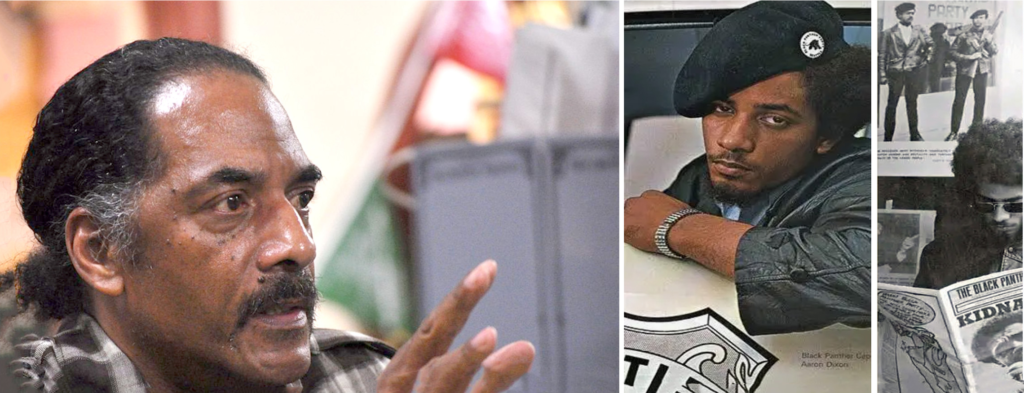
Aaron Dixon Speaks In Spokane
Reflections on the Black Panther Party: Struggles, Successes, and the Ongoing Fight Against Racism
Mar 20 – 22, 2026
Aaron Dixon is a longtime organizer, author, and movement leader whose life’s work spans Black liberation struggles, community health, housing justice, and youth leadership. As a teenager in Seattle, he marched with Martin Luther King Jr. for housing justice and was an early participant in school integration efforts – experiences that shaped his lifelong commitment to racial and economic justice. FOR MORE BIOGRAPHICAL INFORMATION: https://www.thehistorymakers.org/biography/aaron-dixon-41
1. Early Experiences and the Formation of the Black Panther Party
– Dixon’s first experience with racism occurred in high school during a championship basketball game, leading to a desire to end integration.
– At the University of Washington, he helped form the first Black Student Union, which led to shutting down a high school due to racism and subsequent arrest.
– While in jail, the news of Martin Luther King Jr.’s assassination prompted Dixon to consider replacing protest signs with guns.
– He met Bobby Seale at a Black Student Union conference and invited him to Seattle, leading to the formation of the first Black Panther Party chapter outside of California. He was named Captain of the chapter.
– Initial requirements for members included having two guns, two thousand rounds of ammunition, and reading two hours daily from a provided book.
– Dixon recounted the story of Little Bobby Hutton, the first person to join the Black Panther Party at 14, and the first Panther to die in a shootout with police on the same day as King’s assassination.
2. Ideology, Evolution, and Challenges of the Black Panther Party
– Huey P. Newton, Black Panther Party co-founder, was described as a genius who learned to read later in life and became an avid reader of classics and history.
– Newton emphasized the importance of the Black Panther newspaper and taught that “power is the ability to define a phenomenon and make it act in a desired manner,” equating it to media control.
– The party evolved from black nationalism to internationalism, supporting liberation movements globally.
– Core teachings included “nothing remains outside of change” and “everything is in a constant state of flux.”
– In 1968, J. Edgar Hoover, Richard Nixon, and Attorney General John Mitchell declared the Black Panther Party the “number one threat to America’s security.”
– COINTELPRO, a secret FBI program, was initiated to eliminate the party and other radical organizations, leading to heavy infiltration. Early targets of COINTELPRO included Huey P. Newton, who was arrested and jailed.
– Prominent Black Panther leaders Bunchy Carter and John Huggins were assassinated in Los Angeles in January 1969, and Fred Hampton in Chicago in December 1969.
3. Fred Hampton and the Rainbow Coalition
– In 1968 Fred Hampton initiated the Rainbow Coalition, uniting poor whites, Latinos, and the black community in Chicago.
– He convinced Cha Cha Jimenez to transform the Young Lords gang into a political organization.
– An envoy was sent to poor white communities in North Chicago to highlight common struggles, leading to the formation of the Young Patriot Party.
– Hampton also encouraged Chicago gangs to collaborate with the Black Panther Party.
4. Community Service and Survival Programs
– The party realized guerrilla warfare was not viable in America and adopted a strategy focused on community service.
– The Free Breakfast for Children Program was the first initiative, addressing hunger among schoolchildren, which J. Edgar Hoover allegedly called a “number one threat.”
– Fourteen free medical clinics, known as “survival programs,” were opened nationwide, including one in Seattle that remains open.
– Doctors, such as neurosurgeon Dr. John Green in Seattle, volunteered their time for the medical clinics.
– Other survival programs included free legal aid, transportation to prisons, and clothing programs.
– These programs were funded through donations from businesses, supermarkets, and individuals, as the party rejected government funding.
5. The Black Panther Newspaper and International Presence
– The newspaper was considered the party’s “most important weapon” and “voice of the people,” with a worldwide circulation of three hundred thousand copies at its peak.
– Every Panther was required to sell one hundred newspapers a day.
– The newspaper staff included editors, photographers, and artists like Emery Douglas, who developed artwork for the newspaper, recognizing that poor communities were often visual learners.
– Distribution faced challenges, requiring creative methods like flying prints to different cities.
– The Black Panther Party had an international presence with sections in Algeria, India, New Zealand, Australia, the United Kingdom, and support communities throughout Europe and Japan.
6. Electoral Politics, Internal Splits, and Demise
– The party became involved in electoral politics, supporting Shirley Chisholm’s presidential bid in 1972 and in Oakland running Bobby Seale for mayor and Elaine Brown for city council. Although Seale and Brown did not win, the party successfully elected Lionel Wilson in 1977, gaining control of Oakland.
– A significant split occurred due to Eldridge Cleaver advocating for guerrilla warfare, which Huey P. Newton and others deemed suicidal. This led to the formation of the Black Liberation Army by some members who joined Cleaver.
– Huey called for centralization in Oakland, and the party developed a plan to take control of the city.
– The party also opened the Oakland Community School, an alternative school for Panther children.
– Huey P. Newton’s return from prison saw him as a worldwide hero but also struggling with cocaine addiction, which contributed to the party’s demise.
– Aaron Dixon left the Black Panther Party in 1978, and the party officially dissolved in 1982. Despite negative aspects, the Black Panther Party left a “tremendous legacy” recognized globally.
7. Current Political Climate and Activism
– Dixon drew parallels between the fascism faced in 1969 under Richard Nixon and the current political climate.
– Concern was expressed about the current president, described as a “madman” whose actions are threatening America and the world.
– The unification of people against the current administration was highlighted, with Minnesota cited as an example of fighting fascism.
– It was noted that some who voted for the current president are now denouncing him, and several cities in “red states” have refused to allow ICE to build concentration camps.
– This situation presents an opportunity to build a broad coalition and fight back.
8. Personal Political Engagement and Policy Advocacy
– Aaron Dixon ran for the US Senate in 2006 for the Green Party against Maria Cantwell to change her vote on the Iraq War. The campaign also focused on areas affected by NAFTA.
– Dixon was arrested for attempting to enter a televised debate after the Green Party was excluded, an incident that garnered national TV coverage.
– Dixon advocates for free healthcare and decent housing, noting the US is one of the few countries without free healthcare.
– Historical tax rates were discussed, noting that before Ronald Reagan’s election, the wealthy were taxed at 70% and corporations at 60%, which Reagan significantly reduced, contributing to economic disparities.
– Reagan’s actions also led to the deterioration of unions and the legalization of pharmaceutical advertising on TV.
9. Advice for Contemporary Movements
– EDUCATION & STUDY: Emphasize reading history, understanding global movements, and continuous self-education.
– YOUTH DEVELOPMENT: Create programs that teach young people business, literacy, values, and discipline.
– GLOBAL INSPIRATION: Learn from revolutionary leadership such as Captain Trioria of Burkina Faso.
– COMMUNITY FOCUS: Prioritize the most vulnerable (elderly, disabled) and create aid programs based on “neighbors helping neighbors.”
– SELF CARE & TRAUMA: Highlight the importance of self-care, meditation, yoga, and travel for dealing with trauma and anger, especially within the black community, and helping people overcome addiction.
– AVOIDING PAST MISTAKES: Advise against trying to recreate the “Black Panther Party” or wearing their uniform, but instead learning from their actions and mistakes.
– ROLE OF GUNS: Clarify that the party de-emphasized guns but kept them for self-defense, agreeing that everyone should know how to protect themselves.
10. Key Points
– Regarding infiltrators, the advice was to stay focused on the agenda, not allow them to derail efforts, and to exclude known provocateurs.
– Getting people clean and sober was affirmed as a key point of struggle for survival organizations, linking drug use to trauma and anger and emphasizing early intervention with young people.
– A participant noted a perceived lack of large-scale protest movements despite current political issues.