Skip to primary content
Skip to secondary content

Robert Lloyd Artist & Advocate

Building The Community You Are Looking For

Robert Lloyd Artist & Advocate

Main menu

  • Home
  • Site Map
  • Mission 2025
  • Empowerment
    • Navigating Civil Disobedience
    • EMPOWERMENT OPPORTUNITIES AND RESOURCES
    • People Get Ready There’s a Train a Comin’
    • Who Are the True Believers?
  • Tools
    • Which Side Are You On?
    • Mobilizing Effective Political Power with Five Calls
    • 198 NV Actions
  • Culture
  • History
  • NOW

Category Archives: Civil Engagement

Post navigation

Newer posts →

Social Media Platforms in Protests & Civil Disobedience

Posted on July 17, 2025 by Robert Lloyd
Reply

Social media platforms are central tools in organizing, amplifying, and documenting protest movements, including both legal demonstrations and acts of civil disobedience. Their influence extends to nearly every phase of modern activism.

Key Functions of Social Media in Protests

Organization and Mobilization

    • Rapid Communication: Platforms like X (formerly Twitter), Facebook, WhatsApp, and Telegram enable instant alerts and updates to large audiences.
    • Event Coordination: Details about protest times, locations, and changes can be distributed quickly.
    • Recruitment: Movements reach new supporters, often beyond traditional activist circles.

    Information Sharing

      • Education: Infographics, videos, and threads explain protest goals, legal rights, and safety tips.
      • Real-Time Updates: Live streams and posts provide on-the-ground news, especially when mainstream media coverage is lacking.
      • Resource Distribution: Legal aid contacts, medical help, or transportation details are easily shared.

      Public Awareness and Narrative Control

        • Framing the Message: Movements can frame their demands and actions, independently of government or traditional media narratives.
        • Viral Content: Hashtags and viral posts can bring national or global attention to local issues quickly.

        Documentation and Evidence

          • Recording Events: Videos and photos document both peaceful protest and any incidents of violence or repression.
          • Accountability: Livestreams and real-time sharing can deter misconduct by authorities and provide evidence for legal defense.

          Solidarity and Morale

            • Community Building: Supporters express solidarity, encourage one another, and build a sense of collective purpose.
            • International Support: Protests in one country can inspire or support similar movements elsewhere. Risks and Challenges

            Surveillance and Infiltration

              • Monitoring: Law enforcement may monitor public posts or infiltrate private groups.
              • Data Collection: Social media data can be used in prosecutions or to target activists.

              Disinformation and Smear Campaigns

                • False Narratives: Opponents may spread misinformation or attempt to discredit the movement.
                • Trolling and Harassment: Activists may face online abuse or threats.

                Privacy Concerns

                  • Doxxing: Personal information may be exposed.
                  • Platform Policies: Posts or accounts can be removed, limiting reach or erasing documentation. Best Practices for Protesters on Social Media
                  • Use Encrypted Messaging Apps: For sensitive coordination, prefer Signal, Telegram (private chats), or similar platforms.
                  • Limit Location Sharing: Disable geotags and avoid posting live locations unless necessary.
                  • Use Pseudonyms: Protect personal identity where possible.
                  • Fact-Check Information: Prevent spread of rumors or unverified claims.
                  • Backup Important Content: Download key videos/photos in case accounts are suspended or content is removed. Conclusion

                  Social media is a double-edged sword: It empowers protest movements with unprecedented coordination and amplification, but also exposes activists to risks. Effective protest training now always includes a section on digital security, smart communication, and narrative control through social media.

                  Share this:

                  • Email a link to a friend (Opens in new window) Email
                  • Share on Facebook (Opens in new window) Facebook
                  • Print (Opens in new window) Print
                  • Share on WhatsApp (Opens in new window) WhatsApp
                  • More
                  • Share on Reddit (Opens in new window) Reddit
                  • Share on X (Opens in new window) X
                  • Share on Pinterest (Opens in new window) Pinterest
                  • Share on Tumblr (Opens in new window) Tumblr
                  • Share on Telegram (Opens in new window) Telegram
                  • Share on LinkedIn (Opens in new window) LinkedIn

                  Like this:

                  Like Loading...
                  Posted in Actions, Civil Disobedience, Civil Engagement, Direct Action | Leave a reply

                  Organizing Effective and Peaceful Protest Training

                  Pre-Workshop Preparation


                  -Legal consultation: Connect with civil rights attorneys familiar with local protest laws
                  -Venue selection: Choose accessible locations with proper facilities
                  -Materials: Prepare handouts on legal rights, emergency contacts, and safety protocols

                  Workshop Agenda Structure

                  Session 1: Legal Rights and Responsibilities (60 minutes)

                  • Know your constitutional rights (1st Amendment protections)
                  • Understanding permit requirements and legal protest zones
                  • Interaction protocols with law enforcement
                  • Legal observer roles and documentation
                  • What to do if arrested

                  Session 2: Nonviolent Resistance Principles (45 minutes)

                  • Historical context and effectiveness of peaceful protest
                  • De-escalation techniques
                  • Maintaining discipline under pressure
                  • Building coalition and inclusive messaging

                  Session 3: Safety and Security (45 minutes)

                  • Personal safety protocols
                  • Communication systems and emergency contacts
                  • Identifying potential risks and exit strategies
                  • Medical considerations and first aid basics
                  • Digital security and privacy protection

                  Session 4: Effective Organization and Messaging (60 minutes)

                  • Clear goal setting and achievable objectives
                  • Media engagement and public communication
                  • Social media strategy and documentation
                  • Building sustainable movements
                  • Coordination with other groups

                  Session 5: Practical Scenarios and Role-Playing (45 minutes)

                  • Simulated interactions with counter-protesters
                  • Practice with media interviews
                  • Response to various law enforcement scenarios
                  • Group decision-making under pressure

                  Key Training Components

                  Facilitator Requirements:

                  • Experienced organizers or civil rights advocates
                  • Legal experts familiar with protest law
                  • Conflict resolution specialists
                  • Community leaders with grassroots experience

                  Follow-up Support:

                  • Ongoing legal hotline access
                  • Regular check-ins with participants
                  • Resource sharing networks
                  • Mental health and trauma support

                  The most effective protest training emphasizes peaceful, legal, and strategic action while ensuring participants understand both their rights and responsibilities as citizens engaging in democratic processes.

                  Share this:

                  • Email a link to a friend (Opens in new window) Email
                  • Share on Facebook (Opens in new window) Facebook
                  • Print (Opens in new window) Print
                  • Share on WhatsApp (Opens in new window) WhatsApp
                  • More
                  • Share on Reddit (Opens in new window) Reddit
                  • Share on X (Opens in new window) X
                  • Share on Pinterest (Opens in new window) Pinterest
                  • Share on Tumblr (Opens in new window) Tumblr
                  • Share on Telegram (Opens in new window) Telegram
                  • Share on LinkedIn (Opens in new window) LinkedIn

                  Like this:

                  Like Loading...
                  Posted in Actions, Civil Disobedience, Civil Engagement, Direct Action, Empowerment, Protest

                  Who Are the True Believers?

                  The Psychological Makeup of the “True Believer” in Eric Hoffer’s Book

                  Eric Hoffer’s “The True Believer: Thoughts on the Nature of Mass Movements” (1951) is a seminal work that examines the psychology of individuals who become deeply committed to mass movements, whether political, religious, or social. Hoffer’s analysis focuses on the motivations and characteristics of these “true believers” and the conditions that make mass movements thrive.

                  Key Psychological Traits of the True Believer

                  1. Discontent with the Present Self: True believers often feel a deep dissatisfaction with their personal lives. They see themselves as ineffectual, powerless, or insignificant and seek to escape this reality by merging their identity with a larger cause or movement [1]. Hoffer argues that this dissatisfaction drives people to seek meaning and purpose in something external, often leading them to embrace ideologies that promise radical change.

                    2. Desire for Certainty and Simplicity: True believers are drawn to movements that offer clear, black-and-white answers to complex problems. They crave certainty and are often intolerant of ambiguity or nuance.

                    3. Willingness to Sacrifice Individuality: Hoffer notes that true believers are willing to subordinate their individuality to the collective identity of the movement. This allows them to feel part of something greater than themselves, which can be empowering but also leads to fanaticism.

                    4. Frustration and Resentment:!Many true believers harbor feelings of frustration and resentment, often directed at society, elites, or other groups they perceive as responsible for their struggles. This resentment fuels their commitment to the movement and their willingness to fight for its goals.

                    5. Faith in a Glorious Future: True believers are often motivated by a vision of a utopian future promised by the movement. This vision gives them hope and a sense of purpose, even if it requires sacrificing the present [2].

                    6. Susceptibility to Leadership: Hoffer emphasizes that true believers are often drawn to charismatic leaders who embody the ideals of the movement and provide a sense of direction and unity.

                      Comparison to Modern “True Believers”

                      The psychological traits Hoffer identified remain relevant today and can be observed in the followers of contemporary political figures like Donald Trump, Kamala Harris, Barack Obama, and Bernie Sanders. While the specific ideologies and movements differ, the underlying motivations and behaviors of their most ardent supporters often align with Hoffer’s analysis.
                      1. Donald Trump: Many of Trump’s most devoted supporters exhibit traits of true believers, such as a strong desire for certainty, resentment toward perceived elites, and faith in Trump’s promises to “Make America Great Again.” His charismatic leadership and ability to channel frustration into a cohesive movement resonate with Hoffer’s description of mass movement dynamics.
                      2. Kamala Harris and Barack Obama: Supporters of Harris and Obama often emphasize their hope for a more inclusive and equitable future. While their movements may not exhibit the same level of fanaticism as others, the faith in their leadership and vision for change reflects some of the psychological traits Hoffer described, particularly the desire for a better future and identification with a collective cause [2].
                      3. Bernie Sanders: Sanders’ supporters often align with Hoffer’s analysis of frustration and resentment, particularly toward economic inequality and corporate power. His movement’s focus on systemic change and a vision of a more just society appeals to those seeking meaning and purpose through collective action.

                      Key Differences in Modern Contexts

                      While the psychological makeup of true believers remains consistent, modern mass movements are shaped by new factors:

                      • Social Media: Platforms like Twitter and Facebook amplify the reach of mass movements, allowing true believers to connect and organize more easily. This can intensify the sense of belonging and reinforce ideological echo chambers.
                      • Polarization: Modern politics is highly polarized, which can deepen the divide between opposing groups of true believers and increase the intensity of their commitment.
                      • Polarization: Modern politics is highly polarized, which can deepen the divide between opposing groups of true believers and increase the intensity of their commitment.
                      • Diverse Ideologies: Unlike the mid-20th century, today’s mass movements span a broader range of ideologies, from progressive to conservative, reflecting the complexity of modern societies.

                      Conclusion

                      Eric Hoffer’s insights into the psychology of the true believer remain strikingly relevant in understanding the dynamics of modern mass movements. Whether supporting Donald Trump, Kamala Harris, Barack Obama, or Bernie Sanders, true believers today share many of the same psychological traits Hoffer identified: dissatisfaction with the present, faith in a better future, and a willingness to subordinate individuality to a collective cause. However, the tools and contexts of modern movements—such as social media and political polarization—have added new dimensions to the phenomenon.

                      Share this:

                      • Email a link to a friend (Opens in new window) Email
                      • Share on Facebook (Opens in new window) Facebook
                      • Print (Opens in new window) Print
                      • Share on WhatsApp (Opens in new window) WhatsApp
                      • More
                      • Share on Reddit (Opens in new window) Reddit
                      • Share on X (Opens in new window) X
                      • Share on Pinterest (Opens in new window) Pinterest
                      • Share on Tumblr (Opens in new window) Tumblr
                      • Share on Telegram (Opens in new window) Telegram
                      • Share on LinkedIn (Opens in new window) LinkedIn

                      Like this:

                      Like Loading...
                      Posted in Accomplice, African American Voice, BIPOC Artists, Black - African American, Civil Disobedience, Civil Engagement, Civil Rights Movement, Community Icons, Direct Action, Empowerment, Faith, PJALS, Politics, Poor People's Campaign, Trump, Veterans For Peace Spokane, Youth

                      Why Are People So Afraid That They Choose Tyranny Over Democracy


                      During the last few weeks millions have taken to US streets in urban, suburban and rural communities. They came to express their disapproval of the direction the government is moving. But why are so many others so afraid that they would choose a dictatorship, a monarchy or a strongman government? How can this be changed?

                      • Why these fears?
                      • Why Blacks will resist the loss of democracy
                      • What needs to be done?
                      • How can we do it?

                      why these fears?

                      This is a complex sociological and political question. Let’s break down the various fears and concerns that may influence support for authoritarian or strongman leaders.

                      Economic and Class-Based Fears

                      Working Class Concerns:

                      • Fear of continued economic displacement due to globalization and automation
                      • Anxiety about declining manufacturing jobs and wage stagnation
                      • Concerns about being “left behind” by rapid economic changes
                      • Fear of losing social status and economic security

                      Middle Class Anxieties:

                      • Worry about downward mobility for their children
                      • Healthcare cost concerns
                      • Education affordability fears
                      • Housing market pressures

                      Cultural and Social Fears

                      Demographic Change Anxiety:

                      • Fear of becoming a minority in traditionally majority-white communities
                      • Concerns about rapid cultural change
                      • Language and cultural preservation worries
                      • Immigration-related anxieties

                      Traditional Values Concerns:

                      • Fear of erosion of traditional family structures
                      • Religious freedom concerns
                      • Worry about changing gender roles and expectations

                      Demographic Breakdown

                      By Race/Ethnicity:


                      -White Americans (particularly rural/suburban): Higher rates of support often correlate with fears of demographic displacement, economic competition, and cultural change
                      -Hispanic Americans: Mixed patterns, with some supporting strong immigration enforcement due to economic competition concerns
                      -Black Americans: Generally lower support, but some concerns about economic competition and traditional values
                      -Asian Americans: Varied responses, with some supporting merit-based policies and law-and-order approaches

                      By Gender:


                      -Men: Often drawn to strongman imagery and promises of restored traditional masculine roles
                      -Women: More complex patterns, with some attracted to security promises while others concerned about reproductive rights and gender equality

                      By Age:


                      -Older Americans: Concerns about rapid social change and nostalgia for perceived “simpler times”
                      -Younger Americans: Generally less supportive, but some attracted to anti-establishment messaging

                      LGBTQ+ Community Considerations

                      The LGBTQ+ community generally show slower support for authoritarian movements due to:

                      • Historical persecution under authoritarian regimes
                      • Concerns about rollback of civil rights protections
                      • Fear of discrimination and marginalization

                      However, some subset concerns include:


                      -Security fears (particularly after incidents like the Pulse nightclub shooting)
                      -Economic anxieties that may override other concerns
                      -Single-issue voting on topics like immigration or taxes

                      Psychological and Social Factors

                      Authoritarian Personality Traits:

                      • Preference for order and hierarchy
                      • Discomfort with ambiguity and complexity
                      • Desire for clear, simple solutions
                      • Attraction to strong leadership figures

                      Social Identity Threats:

                      • Fear of group status decline
                      • In-group/out-group thinking
                      • Zero-sum worldview (believing others’ gains mean their losses)

                      Media and Information Environment

                      -Echo chambers reinforcing existing fears
                      -Disinformation amplifying perceived threats
                      -Social media algorithms promoting divisive content
                      -Declining trust in traditional institutions

                      Important Caveats

                      1.Individual variation: People within demographic groups have diverse views
                      2.Multiple motivations: Support often stems from combinations of factors
                      3.Context matters: Local conditions significantly influence attitudes
                      4.Temporal changes: These patterns shift over time with events and generational change

                      Why Blacks will Resist the loss of democracy

                      The fight against authoritarianism represents a continuation of a centuries-long struggle for true democratic participation and protection under law. CLICK HERE

                      Fighting Fear Articles

                      1. Why Are People So Afraid That They Choose Tyranny Over Democracy

                      2. Why Blacks Will Resist the Loss of Democracy

                      3. What Needs To Be Done to Relieve Fear?

                      4. Join Fighting Fear and Volunteer

                      This page provides examples of how you can be empowered. Feel free to look around 4comculture.com. Please also do research outside of the site.

                      • Share on Facebook (Opens in new window)Facebook
                      • Share on Mail (Opens in new window)Mail
                      • Share on WhatsApp (Opens in new window)WhatsApp
                      • Share using Native toolsShareCopied to clipboard

                      Share this:

                      • Email a link to a friend (Opens in new window) Email
                      • Share on Facebook (Opens in new window) Facebook
                      • Print (Opens in new window) Print
                      • Share on WhatsApp (Opens in new window) WhatsApp
                      • More
                      • Share on Reddit (Opens in new window) Reddit
                      • Share on X (Opens in new window) X
                      • Share on Pinterest (Opens in new window) Pinterest
                      • Share on Tumblr (Opens in new window) Tumblr
                      • Share on Telegram (Opens in new window) Telegram
                      • Share on LinkedIn (Opens in new window) LinkedIn

                      Like this:

                      Like Loading...
                      Posted in Actions, Civil Engagement, Democracy, Education, Empowerment, Life Under Trump, Multicultural, Politics

                      198 Methods of Nonviolent Action

                      Posted on June 16, 2025 by Robert Lloyd
                      2

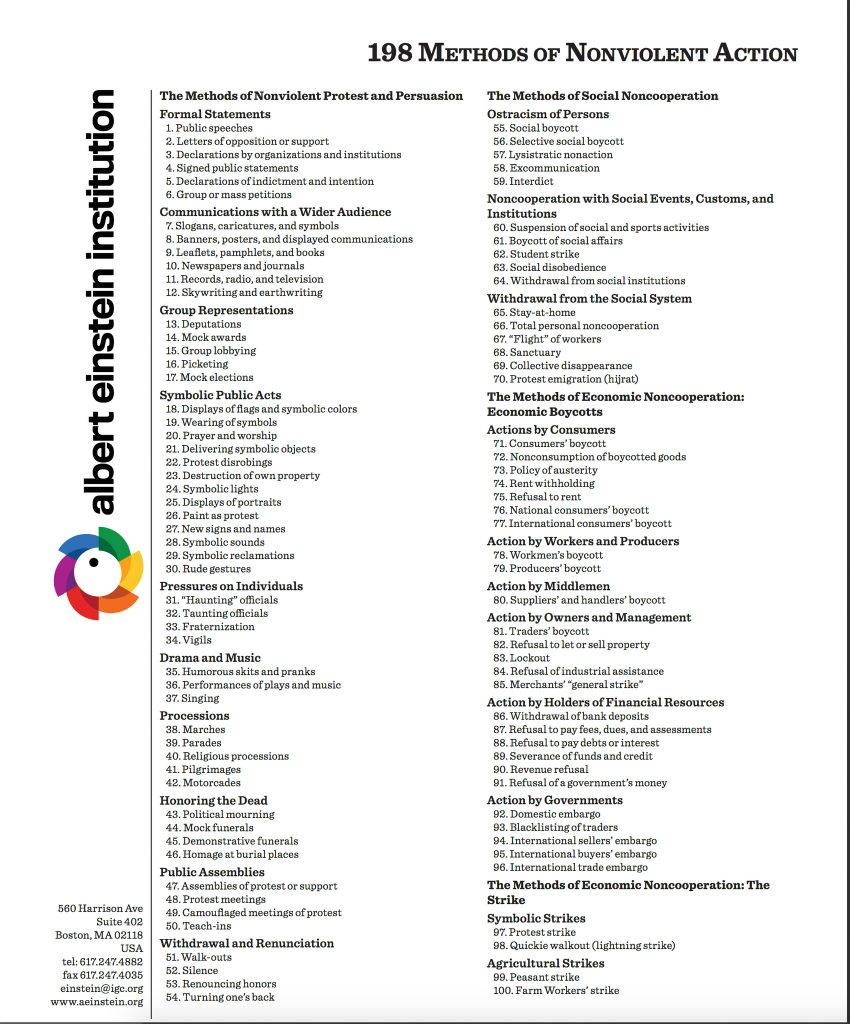
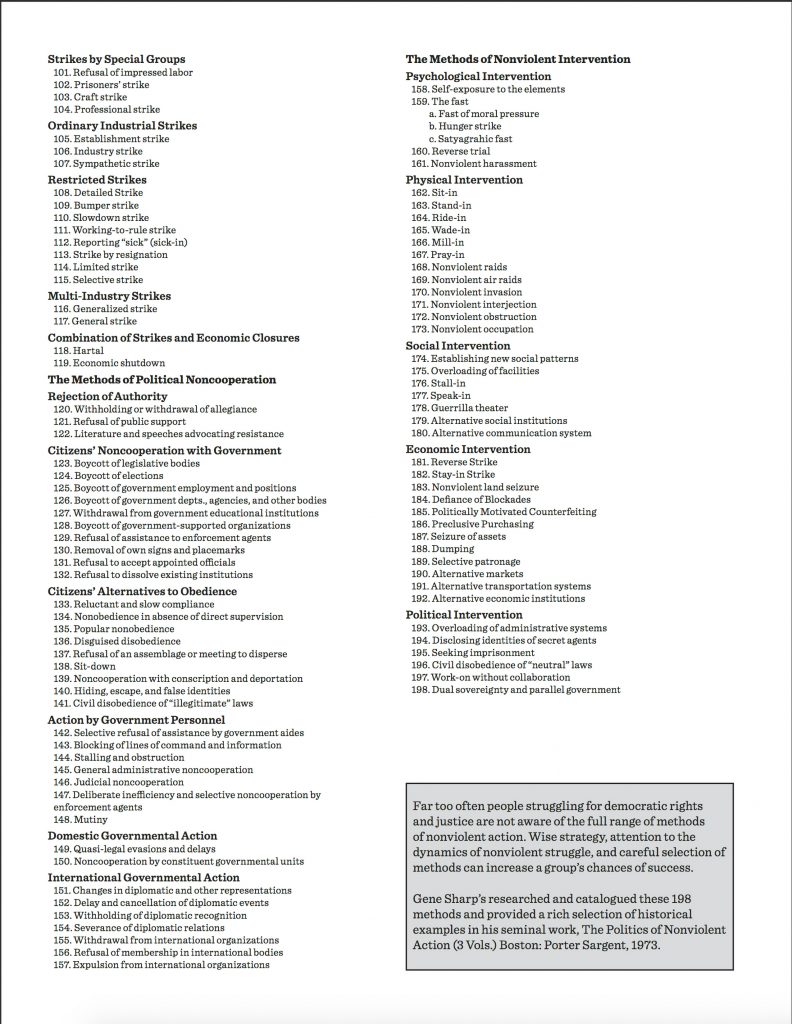
                      Practitioners of nonviolent struggle have an entire arsenal of “nonviolent weapons” at their disposal. Click here to see 198 of them, classified into three broad categories: nonviolent protest and persuasion, noncooperation (social, economic, and political), and nonviolent intervention. A description and historical examples of each can be found in volume two of The Politics of Nonviolent Action, by Gene Sharp
                      Share this:

                      • Email a link to a friend (Opens in new window) Email
                      • Share on Facebook (Opens in new window) Facebook
                      • Print (Opens in new window) Print
                      • Share on WhatsApp (Opens in new window) WhatsApp
                      • More
                      • Share on Reddit (Opens in new window) Reddit
                      • Share on X (Opens in new window) X
                      • Share on Pinterest (Opens in new window) Pinterest
                      • Share on Tumblr (Opens in new window) Tumblr
                      • Share on Telegram (Opens in new window) Telegram
                      • Share on LinkedIn (Opens in new window) LinkedIn

                      Like this:

                      Like Loading...
                      Posted in Actions, Civil Disobedience, Civil Engagement, Direct Action | 2 Replies

                      198 Methods of Nonviolent Action

                      Practitioners of nonviolent struggle have an entire arsenal of “nonviolent weapons” at their disposal. Listed below are 198 of them, classified into three broad categories: nonviolent protest and persuasion, noncooperation (social, economic, and political), and nonviolent intervention. A description and historical examples of each can be found in volume two of The Politics of Nonviolent Action, by Gene Sharp

                      Share this:

                      • Email a link to a friend (Opens in new window) Email
                      • Share on Facebook (Opens in new window) Facebook
                      • Print (Opens in new window) Print
                      • Share on WhatsApp (Opens in new window) WhatsApp
                      • More
                      • Share on Reddit (Opens in new window) Reddit
                      • Share on X (Opens in new window) X
                      • Share on Pinterest (Opens in new window) Pinterest
                      • Share on Tumblr (Opens in new window) Tumblr
                      • Share on Telegram (Opens in new window) Telegram
                      • Share on LinkedIn (Opens in new window) LinkedIn

                      Like this:

                      Like Loading...
                      Posted in Actions, Civil Disobedience, Civil Engagement, Direct Action

                      Call to Action

                      Posted on June 14, 2025 by Robert Lloyd
                      Reply

                      An ostrich can stop a tank when it takes its head out of the sand.

                      Keeping your head in the sand is to choose tyranny. Better to choose nonviolent revolution.

                      Read Choices Now: Tyranny or Revolution?

                      Share this:

                      • Email a link to a friend (Opens in new window) Email
                      • Share on Facebook (Opens in new window) Facebook
                      • Print (Opens in new window) Print
                      • Share on WhatsApp (Opens in new window) WhatsApp
                      • More
                      • Share on Reddit (Opens in new window) Reddit
                      • Share on X (Opens in new window) X
                      • Share on Pinterest (Opens in new window) Pinterest
                      • Share on Tumblr (Opens in new window) Tumblr
                      • Share on Telegram (Opens in new window) Telegram
                      • Share on LinkedIn (Opens in new window) LinkedIn

                      Like this:

                      Like Loading...
                      Posted in Actions, Civil Disobedience, Civil Engagement, Direct Action, Empowerment, Life Under Trump | Leave a reply

                      Your Voice, Our Power

                      Posted on May 23, 2025 by Robert Lloyd
                      Reply

                      Mobilizing Effective Political Power with Five Calls

                      How many of you actually have the Five Calls app? When was the last time you used it? Not enough of us, and that’s why I teach these classes. A lot of people say they want to use it, but then no one shows them how to make those phone calls. Get app at your app store.

                      Talk by Cynthia Hamilton, Indivisible Organizer for Eastern Washington State

                      Share this:

                      • Email a link to a friend (Opens in new window) Email
                      • Share on Facebook (Opens in new window) Facebook
                      • Print (Opens in new window) Print
                      • Share on WhatsApp (Opens in new window) WhatsApp
                      • More
                      • Share on Reddit (Opens in new window) Reddit
                      • Share on X (Opens in new window) X
                      • Share on Pinterest (Opens in new window) Pinterest
                      • Share on Tumblr (Opens in new window) Tumblr
                      • Share on Telegram (Opens in new window) Telegram
                      • Share on LinkedIn (Opens in new window) LinkedIn

                      Like this:

                      Like Loading...
                      Posted in Civil Engagement, Community, Empowerment, INDIVISIBLE, Politics, Social Justice | Leave a reply

                      Mobilizing Effective Political Power with Five Calls

                      Talk by Cynthia Hamilton, Indivisible Organizer for Eastern Washington State

                      Spokane County Democrats Donkey Club Luncheon 5/20/2025

                      Your voice, your power, our democracy

                      How many of you actually have the Five Calls app? When was the last time you used it? Not enough of us, and that’s why I teach these classes. A lot of people say they want to use it, but then no one shows them how to make those phone calls. Get app at your app store.

                      How many of you actually have the Five Calls app? When was the last time you used it? Not enough of us, and that’s why I teach these classes. A lot of people say they want to use it, but then no one shows them how to make those phone calls.

                      We all know that those phone calls are some of the most efficient and effective tools we have as constituents to influence decisions about budgets that could significantly impact our country. So we need to get on board with this now because they’re getting ready to vote on important issues.

                      If you know how to use it, are you teaching others? The usual call volume in D.C. is only about 40 calls per minute for 435 Congress members—that’s just one call for every ten Congress critters! With Five Calls, we once got that number up to 3,000 calls per minute; however, it’s fallen off recently at a time when it’s crucial for us to be making these calls.

                      When I was in Chewelah, WA, I showed everyone how easy it is to use Five Calls—65 people were making calls at once! It was awesome! When I asked them if they thought it was easy many raised their hands affirmatively while others seemed unsure or hadn’t used it yet.

                      So here’s what you need: download the Five Calls app from your Play Store or Apple Store right now—this is your most effective tool for reaching out to your Congress members! Changing my language has been key in my success when communicating with officials; it’s essential that we speak their language if we want our voices heard.

                      Now, have you downloaded the app onto your phone? Great! Are you looking at the issues? Is it helpful? Can I get an amen?! Remember that each phone call represents approximately 10,000 voters because people often feel too intimidated or unqualified to confront someone directly about their concerns.

                      Five Calls provides information about current issues being voted on—it cuts through unnecessary topics and helps focus on what truly matters right now. Once you’ve made a call through this tool, remember you’re representing thousands of other voters!

                      If you’re nervous about talking directly with someone call after hours—call after 2 PM PST (5 pm EST) when they’ve likely gone home and leave a message instead!

                      When using Five Calls again today or tomorrow—or whenever—you’ll see your representative and senators listed, 3 in Washington state – one Congressman and two Senators; don’t forget those Senators even if they seem aligned with our views—they still need feedback from us!

                      It’s vital that we communicate our preferences clearly before votes happen so Congress knows where constituents stand—otherwise they might assume there’s no clear majority opinion and vote accordingly based solely on assumptions rather than facts.

                      Emails hold less weight compared with phone calls since they’re valued at around 1,000 voters each simply because there’s little chance anyone will respond personally—and canned responses don’t help either!

                      An actual letter carries slightly more value but requires far more effort than simply picking up a phone—it may take days before anyone sees your thoughts by which time decisions may already be made!

                      So let’s commit today: teach someone else how easy using Five Calls can be within five days.

                      We cannot remain comfortable anymore—we must start doing things differently starting today—and tomorrow we’ll share knowledge further afield until everyone understands its importance!

                      To find out more about 5 Calls contact Cynthia Hamilton and I’ll help connect you to class sessions available soon: bugsmind@comcast.net

                      Share this:

                      • Email a link to a friend (Opens in new window) Email
                      • Share on Facebook (Opens in new window) Facebook
                      • Print (Opens in new window) Print
                      • Share on WhatsApp (Opens in new window) WhatsApp
                      • More
                      • Share on Reddit (Opens in new window) Reddit
                      • Share on X (Opens in new window) X
                      • Share on Pinterest (Opens in new window) Pinterest
                      • Share on Tumblr (Opens in new window) Tumblr
                      • Share on Telegram (Opens in new window) Telegram
                      • Share on LinkedIn (Opens in new window) LinkedIn

                      Like this:

                      Like Loading...
                      Posted in Actions, Civil Engagement, Community, Empowerment, INDIVISIBLE, Politics, Social Justice

                      Post navigation

                      Newer posts →

                      SCROLL TO SEE OUR POSTS

                      We are often adding new posts and pages. Come back to browse our menu content and posts.

                      SUBSCRIBE

                      ENTER YOUR EMAIL ADDRESS to receive notifications of new posts by email.

                      Join 53 other subscribers
                      Robert J Lloyd

                      Robert J Lloyd

                      Citizen Activist building community I'd like to live in, Retired Professor Art, Photographer, Image Maker.

                      View Full Profile →

                      Recent Comments

                      • Robert J Lloyd on Aaron Dixon Gives the Full Story
                      • littlefenton on Aaron Dixon Gives the Full Story
                      • Tis Eans on Crucifixion
                      • Charles Thomas on Crucifixion
                      • Charles Thomas on MISSION: Art & Advocacy

                      Meta

                      • Log in
                      • Entries feed
                      • Comments feed
                      • WordPress.org

                      Building the community you are looking for.

                      Join us in building the community you are looking for by telling your stories, telling us what is going on in your organizations, posting events, participating in surveys and polls. Subscribe to the site, become a contributor.

                      The Spokane African American Voice does not speak for you. it is a place where you can speak.

                      Archives

                      Contact Us

                      info@4comculture.com

                      4comculture.com ©2011
                      The Spokane African American Voice ©2011

                      Proudly powered by WordPress
                       

                      Loading Comments...
                       

                        %d