March 14 2026, Gonzaga University
Theme: Persist Together, Inspire
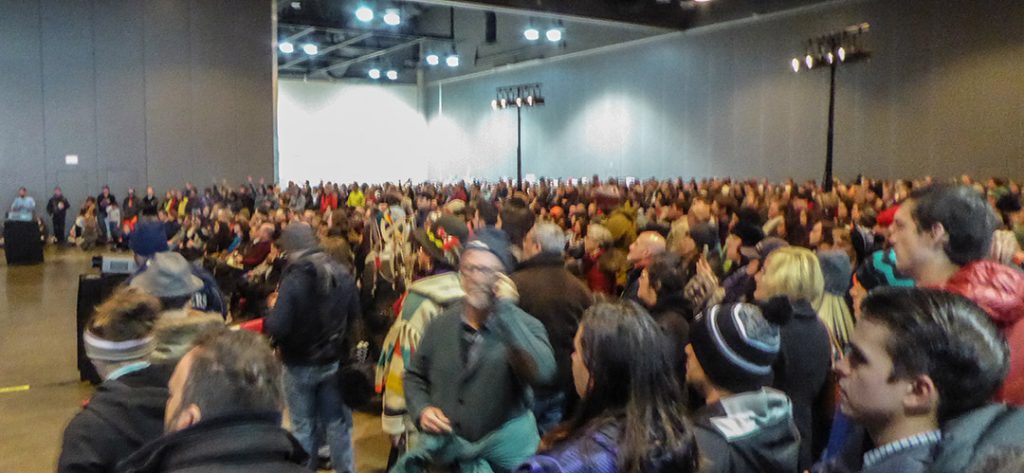
This was not just a banquet to eat and to hear speakers. There was an opportunity for hundreds of people and organizations to network. 4comculture took the opportunity to place whistles on all the tables. [If you want to know what the whistles were about hit the link: https://4comculture.com/building-a-whistle-campaign] At our table it was a great opportunity to share with volunteers with the League of Women Voters and La Prensa, Spokane’s Latino newspaper.
SPEAKERS
Laurel Fish, Senior Organizer, Spokane Alliance
Good afternoon. I see lots of familiar faces. As Gary said, my name is Laurel Fish, and my – I’m the senior organizer for the Spokane Alliance. My own formation as an organizer comes from a few different places. It comes from being the granddaughter of Jewish refugees, comes from experiences working in solidarity with Salvadoran communities, and experiences organizing alongside immigrant hotel and hospitality workers in the labor movement.
The Spokane Alliance, which far predates me, is a broad-based coalition of thirty-eight institutions, faith communities, labor unions, and nonprofits organizing for the common good. We’ve been doing this work for over two decades, but a lot of people don’t know about it because it’s not sexy. It’s not flashy. Developing everyday people as leaders in our democracy, bringing institutions together to hash out their differences, and stand up for their values, and figuring out what people actually want to do to change our community is not the headline-grabbing work that you’d think it would be. A civil rights leader, Ella Baker, said, “It’s spade work. It’s slow and steady.” It’s about persisting together. And The Fig Tree is geared towards sharing those stories.
For example, we can all acknowledge that housing is a major pressure in our community, but it has taken our lay-led housing team over a year of researching solutions, meeting with developers, studying policy, talking to business people, wrestling with how to create policy to start to come up with an idea for publicly financed housing in Spokane, right? And it’s just the beginning.
When I think about our work with the immigrant community, you might have read about the event at First Presbyterian Church, where the Haitian community shared testimony on the eve of the end of their temporary protected status. There were over four hundred and fifty people that packed the church that night. It was an exciting moment, but that public moment was preceded by years and months of hard work and relationship building by Luke, and Katia, and their dad, and Pastor Emily and Daniel Roberts, right? Many people here -that’s what it took. It wasn’t about the moment itself. It was about the persistence that comes afterwards and meeting the next day, the next month, the next year.
And that’s why I appreciate the work of The Fig Tree. They write about people and our motivations and the institutions that we are a part of. I talk a lot about institutions. They get a bad rap, but I think about them as the churches, unions, synagogues, organizations that have stood up for families for reforms like child labor laws, like a minimum wage, like workers’ compensation. They have created, and the people that are part of them have created, everyday miracles of sheltering, nourishing, and humanizing each other.
From my own perspective, my family has weathered some storms recently, and it has taken both strong public policy and strong communities to keep my family intact, right? It has taken paid family medical leave and union health coverage and the state childcare subsidy, and it’s taken grandparents. Thank you, Mom, for helping raise our kids. It’s taken friends picking them up from school. It’s taken colleagues reminding me to eat. All of those, it’s taken institutions and our families to figure out how we shelter and nourish and humanize each other.
Relationships begin by knowing each other’s stories, and I believe that’s what The Fig Tree does. The Fig Tree stories are, for me, a resource guide for the gifts and talents in this community. They’re a starting point for stirring our curiosity about each other, which allows us to act together. Thank you.
Luc Jasmine III, Eastern Washington Governor’s Representative
I want to start off by saying I’m not supposed to be here. I remember sitting in high school, and a teacher told us that most Black men do not make it past twenty-six without being dead or incarcerated. Remember, I was an adolescent hearing this. That comment felt like the heaviest weight ever landing on top of me. It felt that way until I got home. I remember asking my parents, “We are Black, immigrant, and everything is so hard. Even though we’re good people, the statistics show we will not make it. So why do we keep going? Why don’t we give up?” My mom, without hesitation, said in Creole, “Bon Dieu and community.” God and community. Then, just like my mom, she walked off.
Fast-forward today, I fully understand what she meant. There’s so much fear right now. There’s so much to be exhausted by. There’s so many moments where giving up feels like the only logical choice. I look around at rooms like these and see people like you showing up for organizations like The Fig Tree. It energizes me, and it brings me back to that persistence my parents have modeled. Persistence in work, persistence in faith, persistence in love. Somewhere today, a kid will walk into a church, a clinic, a food bank. They will pick up a copy of The Fig Tree. They will see my face, someone who looks like them, someone who keeps going, and that kid will know they can keep going on, too. That moment will happen because of you. Thank you.
LaRae Wiley, Colville Confederated Tribes, Former Director of the Salish School of Spokane
I am going to call up my translator. I really want you to hear our language because it’s beautiful. It’s really critically endangered, so I want you to be able to hear: hear it and hear the sounds, and then I’m gonna share a song too.
Hello, I am N̓ʔiy̓sítaʔtkʷ the water woman, and I am a leader at Salish School of Spokane. And this guy is Chris, the principal, and he takes care of the finances and the school and the kids. And that’s my husband, too. He’s a good man.
The Fig Tree has really helped us. Even when we were small, there was just a few of us down in that basement with a few kids. And that Mary and the Fig Tree helped me, and they’re still helping me. In helping the school, helping us tell our story and to get the word out. And so thank you so much. You’ve done well by us Fig Tree.
I want to sing for you an honor song – a good way to honor your good heart at the Fig Tree.
Reverend David Gortner, Rector, St. Luke’s Episcopal Church in Coeur d’Alene, Idaho
Greetings, everyone, and what a joy to gather together as people eager to make a difference. I’ve had the honor and joy of serving on the board of the Fig Tree for four years, and I continue to be impressed with the care, dedication, and energy of its staff and volunteers. I’m grateful for the stories they share, the connections they build and strengthen, the resources and good work they highlight, and the positive influence they nurture here in our strange little corner of the world.
I want to focus on those first two words of our theme, persist together. These are essential for the good of the world. To persist is to continue firmly and resolutely on a path through thick and thin, not just when it’s smooth sailing, but also when it’s hard, when there’s opposition, when there are barriers or challenges or intermittent failures. We in this room represent a wide range of organizations and groups making a difference in people’s lives, large and small, spiritually, emotionally, physically, relationally, environmentally, economically, educationally.
And a key part of our work is persistence. That dogged showing up and offering what we can steadily and consistently. Building and rebuilding, strengthening and growing where we can. The Fig Tree has provided us at St. Luke’s Episcopal Church in Coeur d’Alene with opportunities to share some stories of ways we are trying to make a difference, large and small, as we persist in a challenging region. By how we model and provide space for courageous, caring conversations. By how we build purposeful partnerships with organizations like North Idaho College and the Human Rights Education Institute. By how we help people follow Jesus’s profound example of unwavering self-giving. That’s today, and we have persisted as the only church in recent years visibly supporting North Idaho College’s faculty and staff through what we might call the recent unpleasantness.
I’m grateful for the ways that the Fig Tree has highlighted our work and the work of so many others. There’s a community being built through these shared stories, so we know we’re not alone, so we learn from each other, so we can form partnerships to persist together with creative passion. The Fig Tree and its resource directory lay out for us a menu of possibilities, but it’s up to us to take the next steps, to reach out and connect with others we haven’t met yet, to encourage each other, to explore ways we can strengthen our impact together. I encourage you to do that today with someone you don’t know.
My wife and I experienced life-changing encounters with leaders of faith-informed organizations during our sabbatical this last summer in countries around the Mediterranean. You may have read about some of what we have to say. We’re going to continue to be saying some things. We’re happy to talk with you today more about the amazing work being done, just to highlight three countries, in Morocco, Spain, and Albania, that involve dedicated interfaith and intercultural partnerships and collaboration. The post-communist resurrection of religions in Albania is nothing short of miraculous.
We came back inspired and eager to build similar partnerships here and to join with partnerships here. You’ll see columns from us in the months to come as we share insights and highlight some of those organizations to support, especially those that have been hurt by the dry up of USAID funding. These organizations in other countries are models for us, persisting, forging new partnerships together, and adapting to new realities. They’re not giving up.
Persisting together begins with getting together like we are today and building relationships together. Yes, we need courage and passion and confidence to step forward. Yes, we need perseverance to stick it out and keep going. But even more, we need each other. So we need to bring a mix of curiosity, humility, and respect to every encounter with each other, to build up new relationships, to sustain and create partnerships, and to keep coming to the table and showing up and inviting others to the table.
Together is a big word, so let’s let our tents stretch wide, and let’s continue to support The Fig Tree in its persistence of giving good voice to the good work being done across our communities, so people will know they’re not alone, that there are partners for the good work we’re all trying to do. We’re all seeking together to make miracles possible. Thank you.
The Fig Tree: Independent, nonprofit newspaper and resource directory in the Inland Northwest https://www.thefigtree.org/