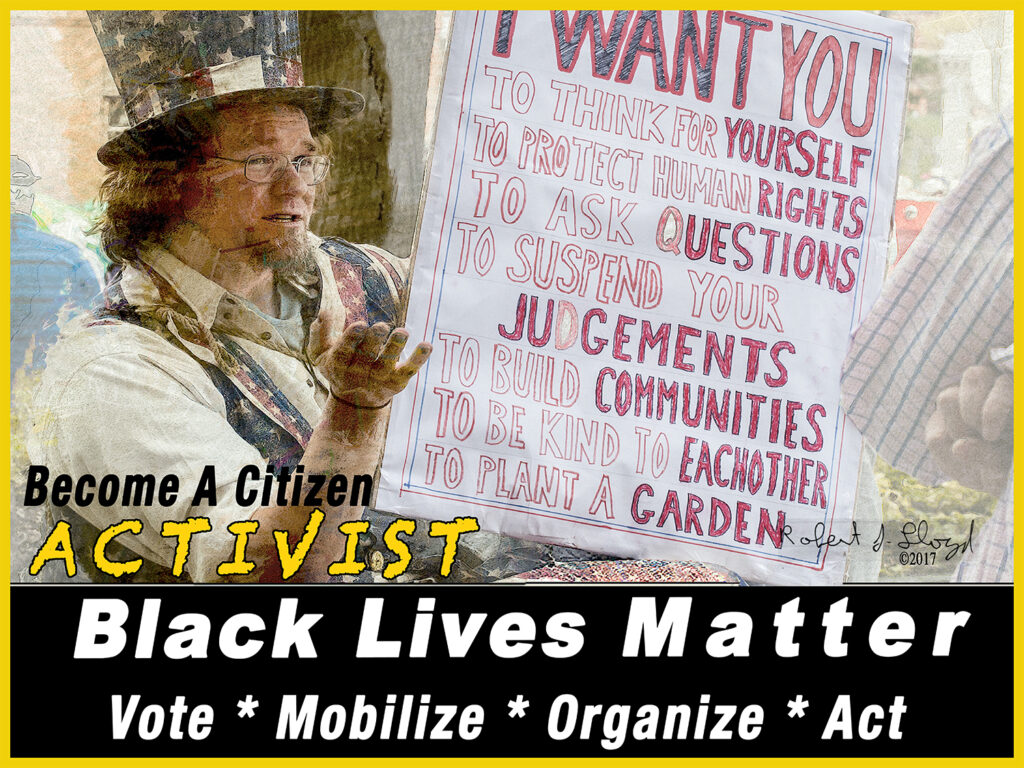
Robert Lloyd worked for CORE and SCLC in Chicago from 1962-1967. After working at Menlo-Atherton High School and Stanford University, in 1974 he completed an MFA in Design and Photography at California Institute of the Arts and began teaching photography at Eastern Washington University.
He founded, directed, and curated The Grand Photography Gallery at Eastern Washington University and The Lloyd Gallery at 123 Arts. From 1996-2000 he founded and published a community newspaper, the Spokane African American Voice. He retired from Eastern Washington University in 2004 after 30 years of teaching photography and digital imaging. After his retirement he photographed in South Africa, Kenya, Uganda, China and Japan. He can be reached at rdlloyd@comcast.net and website 4comculture.com.
Artist Statement
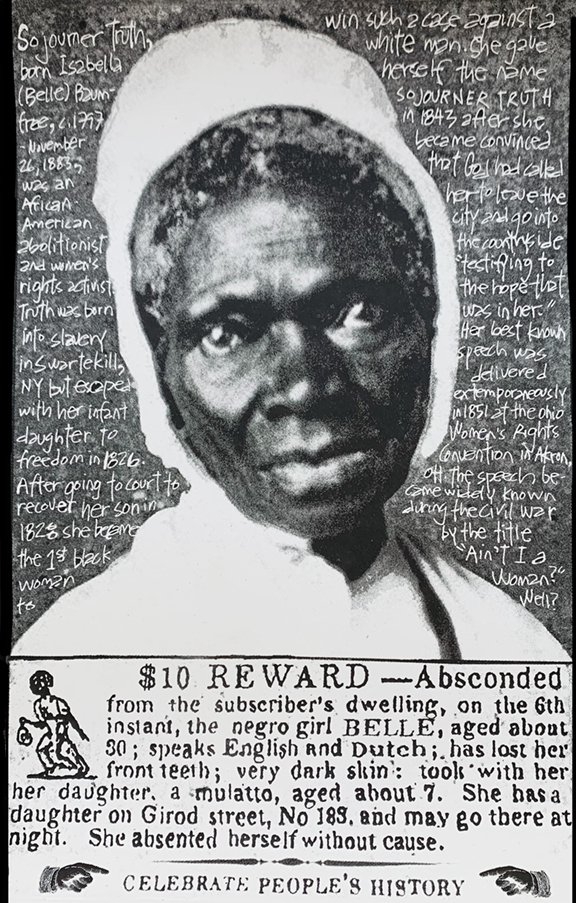
In 2020, the slogan was heard around the world: Black Lives Matter. I found it absurd that Black people were on a mission to get White Americans to accept the fact that Black lives matter. It is my belief that Black lives have always mattered. We only need to listen to the song as we sang it in the Civil Rights Movement, taking off from Paul Robeson’s lyrics “That’s why darkies were born”: Somebody had to pick the cotton, somebody had to plant the corn, somebody had to build a great nation, that’s why darkies were born.
Rachel Doležal has twenty years of experience as an exhibiting artist and art educator. Her works have been featured in The Artist’s Magazine, shown in 14 states, and displayed at the United Nations’ Headquarters in New York. She majored in art at Belhaven College (BA) and in sculpture & painting at Howard University (MFA). Her art is in the permanent collections of Tougaloo College, Howard University, Belhaven College and numerous private collections. Doležal synthesizes history and cultural studies in her art and believes that the creative process is part of what makes us human and shapes our identity in the world. Doležal instructed art as a graduate student at Howard University and helped launch the Howard University Young Artist’s Academy (HUYAA) in 2001, winning numerous awards for her talent. She taught in the Art Departments at North Idaho College and Eastern Washington University. Awards in Art include: Visitor’s Choice Award, Best of Show, Experimental Media Award, and many other gallery awards for her drawing, painting, printmaking and collage work.
Artist Statement
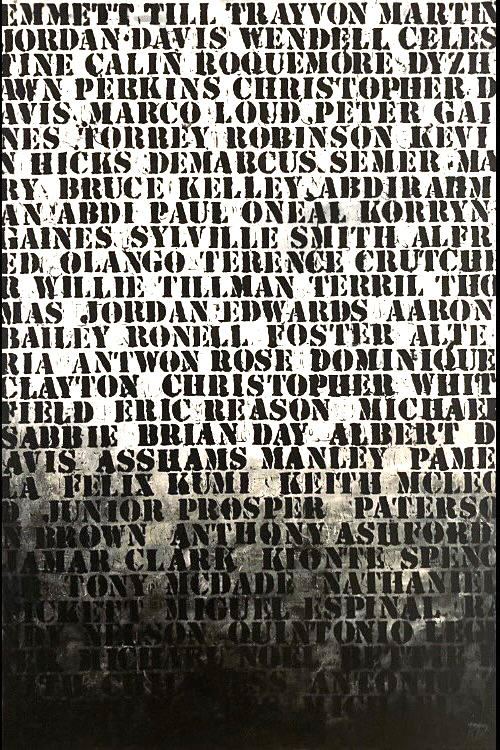
“Anthology I” acrylic on distressed canvas, 24×36” This distress-textured word painting begins with “Emmett Till” and lists 54 names of individuals killed by police brutality or neighborhood vigilantes in the United States. Every 13th name is the name of a female victim, which symbolizes the lesser attention that Black women often receive in media and society than men in similar circumstances. An anthology is a collection of stories, and as we “say their names,” may we also remember the life story represented by each person who was taken from us.
“Anthology II” acrylic on distressed canvas, 24×36” This distress-textured word painting begins with “George Floyd” and is an unfortunate sequel to “Anthology I” as a remembrance of 53 more names of individuals killed by police brutality or neighborhood vigilantes in the United States. Every 13th name is the name of a female victim, which symbolizes the lesser attention that Black women often receive in media and society than men in similar circumstances. An anthology is a collection of stories, and as we “say their names,” may we also remember the life story represented by each person who was taken from us. (Spokane’s own Lorenzo Hayes is included in this piece).
Olivia Evans is a grant-awarded, multidisciplinary visual artist based in Spokane, WA, working in video, photography, drawing, and film. In 2018, she graduated from Eastern Washington University with her Bachelor of Fine Arts in studio art and a minor in film. Her work is heavily influenced by motherhood, the subconscious, nature, and social events — intertwining traditional and digital media to create narratives of the self. All these influences echo her eclectic cultural experiences of growing up in an economically challenged home with her Italian mother and in 2007 (once parents remarried), being reunited with her African American/Native American father.
Olivia is working with The Alliance for Media, Arts, & Culture as a local producer and social media manager. She co-produced the documentary film series Monday Movies at the Magic Lantern Theater, Native Arts & Film Events, and co-curates numerous events in the Pacific Northwest region. She actively participates in the Alliance National Youth Media Network activities and within her art community in Spokane. Her work has been featured in several student exhibitions, Saturate, a city-wide arts event in Spokane, at the Kress Gallery, Terrain 12 (2019), a large exhibition that features over 200+ artists in the PNW.
Artist Statement
As a mother, I have come to terms with having two living bodies develop inside me, feed off my nutrients, and be cut out of my stomach. What was once the essence of myself was now in physical form, staring at me and looking at me for answers, while I was still collecting what remained. It can be easy for people to hide behind their physical form.
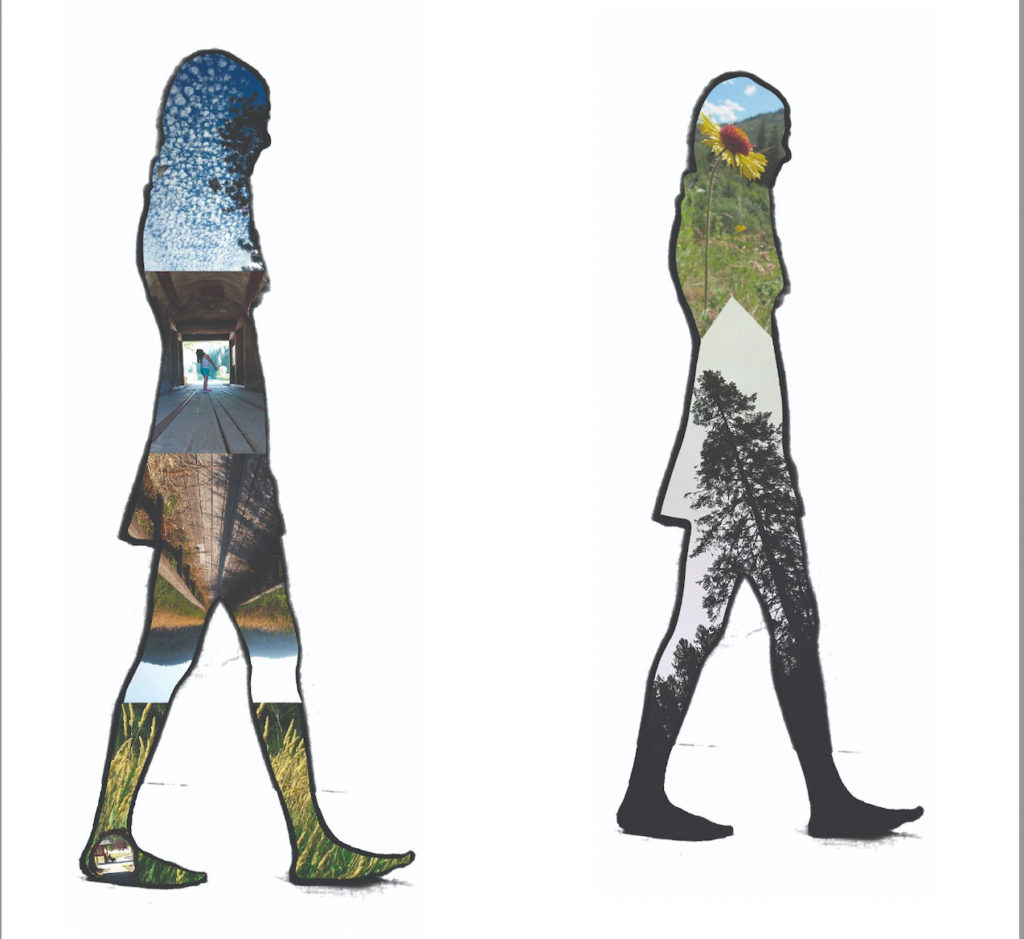
In my work, I investigate our relationship with our subconscious, as well as the significance of movement relative to these fragmented states of mind. Within cultural elements, personal experiences, and recognition of gestural transitions are attached. For instance, the gestural use of walking that offers a meditative bind between the walker’s mind and body. Walking is a recurring theme in most indigenous cultures.
In my video work, I use frame by frame stop motion animations and drawing to create narratives based on personal situations and contemplations. Using inanimate objects, drawings, photographs, and silhouettes to help aid these ideas gives me freedom to choose a route that fits within the situation. In film, I comment on cultural and social meaning, and the sometimes clash of the two. In my still photography projects, I elaborate more on the misconception of memories, our reliance on subconscious thought, and the relevance of the people who we hold dear in our lives.
Our upbringing and cultural background are a huge factor in this. When entering the subconscious, one runs into their innermost desires and memories that convey an intense feeling of nostalgia. We attach these events constantly to our lives to assure ourselves that change is or is not happening – a comfort food to fuel our future endeavors. It’s natural to want to turn back time and relive certain snippets of the past. Is it possible to fully regain that sense of clarity, or is the inevitability of change going to constantly keep us on our toes?
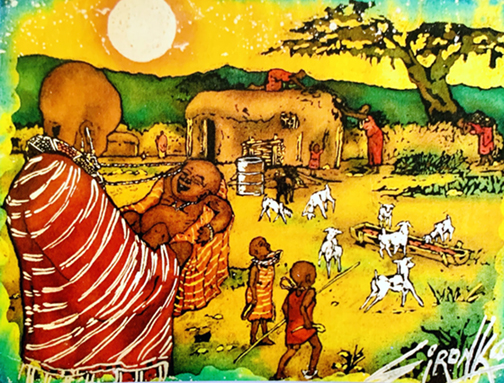
I am Nicholas Sironka, (I go by Sironka) a Maasai batik artist, with a God given talent. I was born and raised in Kenya, a country in East Africa. We have 42 different tribes in Kenya. Each tribe speaks a distinctively different language from the other. There is however a national language that helps all these tribes communicate with each other – Kiswahili. (Remember ‘Hakuna matte” in the movie Lion King?). I am Maasai, a small pastoralist tribe living mostly in the southern plains of Kenya known as the Rift Valley.
In the year 2000, I was awarded the prestigious Fulbright Scholar-In-Residence Award from the U. S. Government to com teach batik art and Maasai culture at Whitworth University in Spokane Washington.
Ever since childhood I was always fascinated by my Maasai culture, a culture that was very much misinterpreted and misunderstood. It is then that I made it my life’s ambition to find a way to tell the truth about my people and to do so with dignity and truth. With my God given talent I determined that batik was the medium I would use to make good of this quest.
Today I sell my original art and enjoy teaching batik art classes and also continue to hold lectures on the Maasai culture whenever I am invited to do so.
My passion to speak on the facets of my culture portrayed in my pieces has many times been impactful emotionally for those buying my art or simply coming and listening to my explanations of deeper meaning for the paintings. Many asked if I was a counselor, and after much thought, I decided to go to school. I am happy to say that today I hold a degree as a certified substance abuse counselor!
My philosophy: “If I can use my talents to touch another life, and make it better, then I will be fulfilling the purpose for which God put me on this Earth!”
I am a very eclectic artist who has made Spokane’s Inland Northwest region my home for the past 20 years. I’m a transplant from the southern metropolitan area of Chicago Illinois. As an artist whose creativity is embodied in the cultural influences of Hip Hop, provides rationale for my indiscriminative usage of a wide range of mediums collaboratively. I consider myself to be an extraordinary individual. I’m quite different from most of my peers. I’ve been given a natural talent to transcend groups. As a young African American, I have always been very curious of other cultures and races. Living in the mid- west exposed me to a very diverse population and my curiosities of that diversity led me to a cultural sensitivity and ability to transcend groups. There has never been any box to place me in.
During my youth I found education to be dissatisfying and often brutal. Having come from a family that was lukewarm about academia, my father was a high school dropout and my mother’s educational peak was eighth grade -I didn’t feel strongly about any kind of learning. The only area that I was actually interested at the time was writing; it was the one medium in which I felt comfortable, rap music and goals of becoming a rapper led to a gifted writing aesthetic.
Due to my empirical experience as an urban minority youth who comes from the unforgiving streets of Chicago, Illinois, I have developed the usage of aesthetics to enact micro-politics, and ethnographical guidance and cultivation.
Growing up in an urban sub-culture gave me extremely valuable tools and life skills. I have survived an extraordinary violent, a dilapidating ignorant, and a horrifically impoverished environment. I have beaten most odds that young black youth face today with grace and humility.
At present, I consider myself to be an activist and advocate. I am an advocate for men that are in the perpetual cycle of domestic violence I am committed to an unconventional approach to changing the hearts and minds of men who have been abused and or abusive. I am an activist for the disenfranchised who suffer discrimination and taxation without representation. I have been very instrumental in lobbying for policy changes in Washington State concerning felony voting rights. I believe that my previous years of hardship and discrimination have developed my character. It has not made me bitter; it has made me better. Life has been my classroom, and adversities, my exams. My memoirs, stories, and experiences I will eventually publish in a book entitled “Successful Failures and Unexpected Accomplishments”.
My rehabilitation has come in the form of higher education, self-assessment, self-understanding, and realization. Becoming maladjusted helped me to tap into resources that led to my discovery of self, through education. Being a high school dropout that suffered from social, physical, and psychological abuse, I became empowered when a Spokane mental health counselor convinced me to pursue education as a means to discover and rid myself of internal issues that plague me.
I have engaged in self-uplift and development. I have evolved into an individual who desires to change, while reaching back for those who don’t have the self-efficacy or resources to mount an attempt.
As you will see, my art is also evolving as I learn more about the Diaspora and the African progeny worldwide. If my body of work affects you in any way emotionally, please use the experience to discover an honest and genuine self-discovery using a one word question during self- thought. Why?
The question I’m asked most frequently is how a black doctor in his 50s working on the Navajo reservation started doing street art on said reservation. In retrospect, it was only natural for this evolution to occur.
I started working in a small community between the Grand Canyon and Monument Valley called Inscription House in 1987. I’d always been drawn to photography and built a darkroom shortly after my arrival on the Navajo Nation. My passion photographically is shooting black and white in a documentary style inspired by people like Eugene Smith, Eugene Richards, Joseph Koudelka and others. By going out and spending time with people in their homes and family camps, I have come to know them as friends. Interestingly, these home visits enhance my doctor/patient relationship by helping me be a more empathetic health care practitioner.
I’ve always been drawn to street art, graffiti and old school hip-hop. I was attracted to the energy of the culture in the 80s and though I was miles away from the epicenter, I thought of myself as a charter member of the Zulu Nation. I would travel to New York City to see graffiti on trains, on buildings and in galleries. I did some tagging in the 80s before coming to the Navajo Nation and participated with a major billboard “correction” on the reservation shortly after my arrival. My early interventions on the street were largely text based saying things like “Thank you Dr. King. I too am a dreamer” or “Smash Apartheid” and so on.
In 2009 I took a 3-month sabbatical to Brasil which coincided with a difficult period in my life. Though I wasn’t looking for an epiphany, I was fortunate to stumble upon a passionate group of artists working on the street who befriended me. It was during this time that I appreciated how photography could be a street art form. Inspired by Diego Rivera and Keith Haring, I’d become disinterested in showing my photographs in galleries isolated from the people I was photographing and wanted to pursue a more immediate relationship with my community reflecting back to them some of the beauty they’ve shared with me. And in truth, I was infatuated with the feeling I got being with the artists in Salvador do Bahia and wanting to find a way to keep that vibe going I started pasting images along the roadside in June 2009.
My early photographic influences include the work of Joseph Koudelka, Garry Winogrand, Charles Moore, Robert Frank, Eugene Smith, Gordon Parks, Larry Towell, Mary Ellen Mark, Susan Meisalis, Roy DeCarava, Sebastio Salgado and Eugene Richards. I was blown away by Richards’ work in the late 80s and early 90s for Life Magazine and had an opportunity to spend 5 days picking his brain at Santa Fe Photographic Workshops in 1991. It’s this one person with one camera, frequently with only one lens shooting black + white film in ambient light aesthetic that informs my eye as well as 25 years spent in my home darkroom pursing the zone system. It’s been an interesting challenge attempting to bring that look to black and white prints on regular bond paper coming off a toner based plotter. I’d like to think that my vision is a part of the storytelling, first person, humanist tradition of the people I look up to mixed with a healthy dose of Diego Rivera + Keith Haring.
Regardless, I give thanks that the journey continues.
Art Institute of Chicago / University of Chicago BFA: Studied Art History, Painting, and Printmaking; Lone Mountain College / University of San Francisco MFA: Studied Aesthetics, Art History, and Printmaking
Information Made His Life Matter By Robert Lloyd
In elementary school when your skin is dark and your nose is broad and your hair is kinky, your peers don’t think your life matters. So, you find a sanctuary in the library. No one beats you up. No one calls you names. You read. You discover how much there is that you don’t know and you can find in a book. A teaching career. A military career. An artist’s career. A medical technical career. A career as a professor of art in Nigeria. African history, philosophy, literature, world travels. Information made his life matter. Charles made his life matter.
Artist Statement
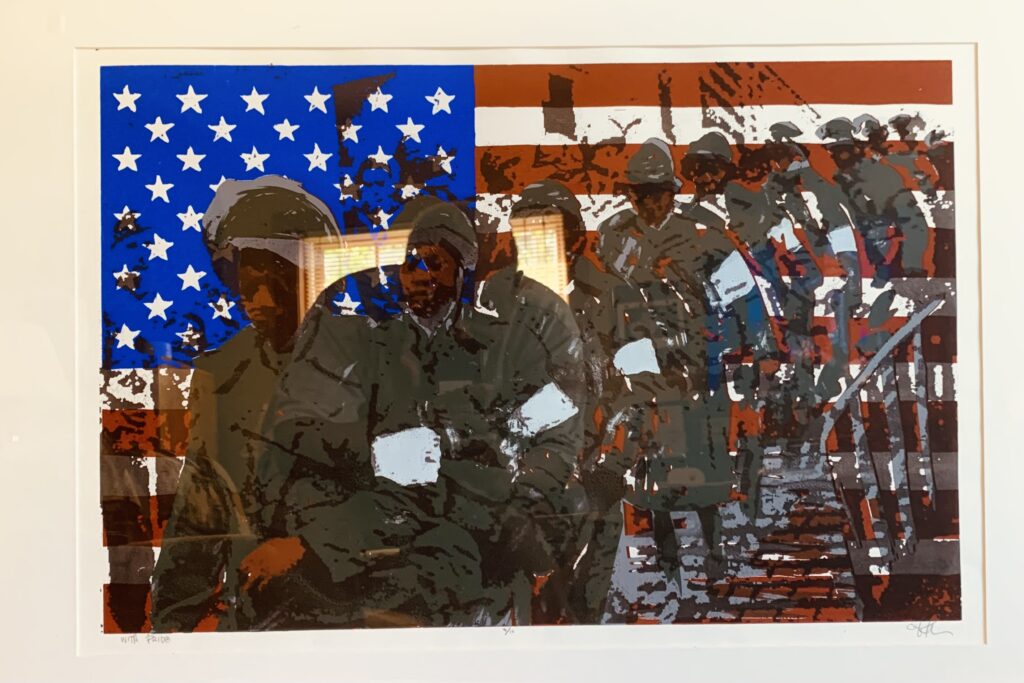
I am interested in bringing into focus a particular space of time which most Americans have avoided. I suppose one could say the idea is not to tell a story or narrate history but rather by presenting fragments of history in visual form, ignite thoughts of history in the viewer’s mind at several levels, conscious and unconscious.
The Nigeria Series
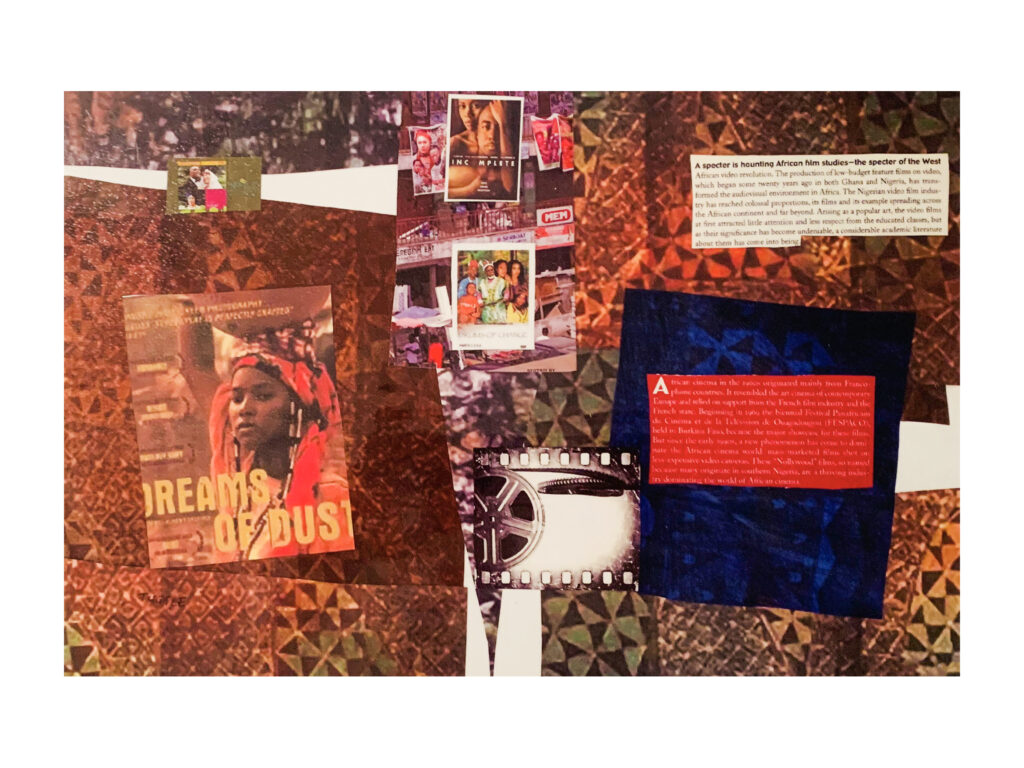
The series of paintings and collages is based on my time living and working in West Africa. To express the feeling that Nigeria evokes in me, visually, I use musicians and scenes of everyday life as representational elements with color and movement as the abstract elements overlying the representational ones. Kind of a theory much like music theory can be viewed as cultural constructs. In Western thought, color is described in visual terms, such as pigment or light. In Nigeria, particular in Yoruba land, where I lived, color was described in terms of temperature, from hot to cold, with various colors also having religious connotations. In Nigeria, art is meant to be multiple, multi sensual experience, not simply a matter of sight, something you look at. This series of art represents a distillation of the many feelings I have for West Africa.
My name is Carl Richardson and I have lived in Spokane for the past 25 years. I am a practicing artist and an Instructor of Art at Spokane Falls Community College. I moved the Northwest to pursue my MFA from Washington State University. Prior to moving to Washington, I lived in Florida. I completed my Bachelor’s degree from the HBCU Florida A&M University.
Artist Statement
I am a 2D artist with a primary interest in printmaking and drawing. The subject and content of my work varies and is influenced by music, conversations, observations, and the state of the world. The consistent thread in my work is my love of formal structure and design. I often use the golden mean or other geometric layouts as a foundation for my compositions. Through the act of creating I am able to express thoughts and feelings that would otherwise remain silent.