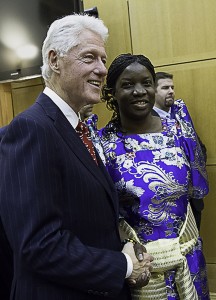
Angela Bukenya Meets President Clinton

Clinton School to Co-host Holiday Performance

As we enter holiday break this weekend at the Clinton School, we wish everyone a wonderful holiday season! Above is a photo from the Clinton Presidential Center holiday party December 18.

NOTE: Angela Bukenya is a June 2012 masters degree graduate of  Eastern Washington University. She attended school, worked in health care, volunteered at the South Hill 7th Day Adventist Church,  was involved in national politics, care for the aged and other health concerns in the Spokane area for several years. She is now working toward a second masters degree at the Clinton School Of Public Service, University of Arkansas,  and met President Clinton at the Clinton Presidential Center holiday party.


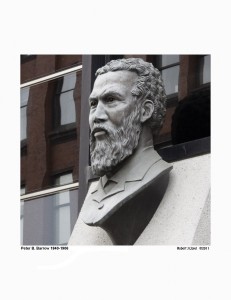
Northwest Black Pioneer: Peter Barnabas Barrow

By Patricia Bayonne-Johnson

Peter Barnabas Barrow was one of many African Americans who migrated to the Pacific Northwest and made a tremendous contribution to the development of the Spokane area.

 Born a slave near Petersburg, Virginia in 1840, Peter was taken to a plantation near Cosita, Alabama. He ran away when the Union Army came through the area early in 1864 and enlisted in Company A, 66th U.S. Colored Infantry on March 11, 1864 when they reached Vicksburg, Mississippi. Peter was appointed Sergeant on November 1, 1865. He served in Louisiana and Arkansas during the remainder of the war. He remained in the Union Army until March, 1866.

After the war, Peter married Julia, settled in Vicksburg and became active in politics.  Peter served as a member of the Mississippi House of Representatives and afterwards as a senator from the district of Vicksburg during reconstruction. Sensing that life was not going to get better in Mississippi, Peter moved his family to Deer Park, Washington, in 1889.  Expressing his fondness for the Northwest at a black voters’ meeting in 1890, Peter announced, “I jumped out of hell and landed in heaven on both feet.” Peter Barrow’s political activities included founding the John Logan Colored Republican Club and being nominated for office by the Populist Party.

Peter became one of the first black landowners in Stevens County, cultivating a huge irrigated apple orchard and was a leader in the Farmers Alliance movement.   Under his direction, the Deer Lake Irrigated Orchards Co. was formed. It was the largest operation of its kind in the Inland Empire and employed about 100 black men. Winter apples were grown and were exported all over the country.

In 1890 Peter Barrow became one of the founders and pastors of Calvary Baptist Church, Spokane’s first black church. He served as pastor from 1895 to 1906. The church is currently located at 213 E. Third Ave.

In 1892 Rev. Barrow moved his family to a house he built at E 2417 Second in Spokane. He and his wife, Julia, had six sons and one daughter.

The Barrow family gave the black community The Citizen, a newspaper published by Charles Barrow, which chronicled the history of Spokane’s black community.  Charles and Olive Barrow are the parents of Eleanor Barrow Chase, wife of James Chase, Spokane’s first and only African American mayor.

Reverend Peter Barnabas Barrow was killed in a streetcar accident on July 28, 1906 while attending a church convention in Tacoma.  He is one of the 12 bronze busts honoring early business and community leaders on the east side of the Spokesman-Review printing building at 1 North Monroe Street in Spokane, Washington. On the installation, “Builders and Leaders” also known as The Spokesman-Review Bronzes, Rev. Barrow is identified as a Pastor, Entrepreneur and a Publisher. I would add Politician and Civil War Veteran.

Note: This story was re-enacted at the 3rd Annual Walking with Ancestors at the Greenwood Memorial Terrace in Spokane on September 22, 2012. Walking with Ancestors is a program presented by the members of the Eastern Washington Genealogical Society who tell the stories of the people buried in the cemetery.  This year’s theme was “Remembering Our Civil War Ancestors.” I requested an African American man for my presentation and my “ancestor” was Peter Barnabas Barrow. I told Peter’s story as Eleanor, Peter’s granddaughter. Eleanor did not know her grandfather because he died in a tragic accident before she was born.

Sources:

Franklin, Joseph, All Through the Night: The History of Spokane Black Americans, 1860-1940 (Fairfield, Washington: Ye Galleon Press, 1989)

Taylor, Quintard, Barrow, Rev. Peter (1840-1906) The Black Past: Remembered and Reclaimed. Black Past.org (an online Reference Guide to African American History)

Peter B. Barrow, Deposition A, April 22, 1895, Civil War Pension File, NARA, Washington, D. C. , Fold 3.

HistoryLink.org; Jim Kershner

The After Life Of An AAVoice Staff Member

Student Studies in Zambia:
Lorenzo, Master of Arts in Transformational Leadership (MATL)

Lorenzo Herman, S.J. is a current student in the Master of Arts program in Transformational Leadership (MATL). We met with Lorenzo recently to learn about his summer trip to Zambia as a part of his internship requirement in the MATL program.

When Lorenzo began the program Fall of 2011, he said that his interest immediately peaked when Dr. Sharon Henderson Callahan, Associate Dean for Academics & Student Life, mentioned in orientation that the internship requirement for the MATL could be fulfilled nationally or internationally through the School’s interdisciplinary options– including through Seattle University’s Nonprofit Leadership, Public Administration, Business and Law programs among others.

For eight weeks this past summer, Lorenzo lived in, explored and researched in Lusaka, the capital city of Zambia, while traveling to other cities within the country on assignment. Lorenzo was based within the Jesuit Centre for Theological Reflection in Lusaka, a centre highly respected throughout Africa for its focus on advocacy for social conditions, faith and justice, outreach and economic efforts. Centre founder, Peter Henriot, S.J., has taught on social analysis at Seattle University School of Theology and Ministry over the years, and his social analysis method is used in the Master of Arts programs in Transformational Leadership, Pastoral Studies, and Transforming Spirituality as well as the Master of Divinity program.

The Centre, along with 26 other organizations that make up the Civil Society Constitution Coalition, is working rigorously with the Zambian government on the first draft of their Constitution and meets weekly at the Centre. 

Prior to his visit, Lorenzo had studied the Constitution at length, and upon his arrival attended meetings with key political figures and stakeholders. In the Constitutional framework, one priority was to include clauses of non-discrimination, including for individuals that have disabilities. The Coalition was finding that the families of individuals with disabilities were directly and indirectly affected by the Constitution, and needed explicit clauses of inclusivity and equality that were monitored and enforced in the community. There were not any representatives from the special needs population or service organizations in the Coalition at that time and some research was needed to further their work on the Constitution.

Lorenzo set out to visit the Ng’ombe compound in Lusaka as a part of this research. Many children throughout Zambia struggle with autism, learning disabilities, cerebral palsy, and down syndrome, among other special needs. There is a special needs school within Ng’ombe called Little Assisi Day School, run by an Irish Franciscan sister, Sister Helen Scully, who also has a background in special needs education. The staff at the school do far more than teach–providing extensive support to mothers and special needs children in the community: from teaching, to healthcare, to home visits, to providing basic supplies for the families.

Lorenzo visited the School and spoke extensively with its staff–asking if he might be able to  interview the mothers of special needs children to find out more about their experiences of medical and social systems in Zambia to provide recommendations to the Centre and Coalition in their work on the country’s Constitution. Lorenzo then interviewed 18 mothers, with the support of two incredible teachers at Little Assisi: Edith and Paula. Each mother that Lorenzo interviewed worked intermittently while living in the community, had 0-6 years of education, had high hopes for their children, families and community, and all experienced some form of discrimination, shame and guilt from their communities because of their children’s struggle. Some reoccurring themes in their stories included housing needs, the lack of food and medical care, desire for self-empowerment and entrepreneurship, and hopes for employment and better transportation. It took two days for Lorenzo to type out 55 pages of notes from these interviews, which he then presented to colleagues from the Centre for evaluation. After evaluating themes as well as their subtexts/contexts that illuminate further their similarities and differences, Lorenzo drafted a succinct list of recommendations for the Centre and Coalition in their work.

This experience is close to both heart and home for Lorenzo, since his sister Leslie was born with hydrocephaly and cerebral palsy, and has experienced multiple surgeries and medical treatments over her 26 years. She currently participates in integrated educational programs and social programs in the community, while benefiting from disability benefits in the United States. Lorenzo shared throughout his interviews of special needs children’s mothers, he often thought of his own mother and her strength and struggle in supporting his dear sister.

Below are photographs from Lorenzo’s trip.

Lorenzo presented his qualitative research study entitled “The Mothers of Children With Learning Disabilities in Lusaka, Zambia” at the School on Thursday, November 29th, from 4:30-5:30pm. The study’s objective was to use the collected information and to make recommendations to the Jesuit Centre of Theological Reflection and to those local and national disability advocacy groups to facilitate making recommendations to reduce the burden of disability discrimination and stigma in Zambia. The focus of this research study was to learn how mothers who have children with a learning disability are affected by their families, faith communities, medical and social systems.

FRESH OFF THE PRESS!
Since we interviewed Lorenzo, he has been elected as President of the National Black Catholic Seminarians Association (NBCSA), which seeks to contribute to the wellbeing of candidates for priesthood and religious life, with an emphasis on Black American, African, Afro-Caribbean, and Afro-Latino candidates preparing to serve the Church in the United States and its territories. The Association is an affiliate of the National Black Catholic Clergy Caucus. The National Black Catholic Seminarians Association also cooperates with the National Black Sisters Conference.

Lorenzo_Zambia1.jpg

From the Soweto Market (above and below)
Lorenzo_Zambia2.jpg


Lorenzo_Zambia3.jpg

Lorenzo comments on the above photo:
“I was walking home one day when I came upon these two boys in front of me. It was endearing to see the public affection they have for each other. They were inseparable and having a great time. I could not understand what they were saying because they were speaking Nyanja but their body language was endearing, playful, and sincere.”

Lorenzo_Zambia4.jpg

Lorenzo shares about this photo, above:
“I thanked the wonderful lady next to me who let me help sell her fish for a while. She thought I was weird for asking. — at Soweto Market.”


Spokane folk’s check out Irish’ Touch

Fresh, fun, eco-friendly clothing for …
Every woman…Every age…Every day!
Please join us for a kikaPaprika Show hosted by
IRISH’S TOUCH
Friday, November 30th, 4:00pm – 7:00pm
122 N. University Rd. Ste. #103
Spokane Valley, WA 99206
Bring a girlfriend or two & be ready to try on the latest designs from this fabulous new clothing line!
Please RSVP to me:
IRISH’S TOUCH at 509-928-6824 or irishstouch@kikapaprika.com

Presented by kikaPaprika Fashion Consultant
Irishs Touch
kikaPaprika is available exclusively through Independent Fashion Consultants.
Visit us online at http://IrishsTouch.kikaPaprika.com
Did you get dressed in a better world today?

Red State Blue State Screaming

Bob has photographed Jay in the red part of a Blue State

Jay Cousins

This election cycle has produced an angry red state blue state screaming match, where the middle of the US seems to hate both coasts, while the coasts deride and demean the values of those in the middle American states. So, I have an observation:The coasts are the most populous areas of the country, and how did they gain that distinction? Through the migration of the people who lived in those Plains states to either of the Coasts. This migration started during the Depression and continues today. A brief review of these changes might prove useful in providing some discussion points.

I will use the example of California as I am from there and know its population changes first hand.

In 1900, the population of California was, 1,485,000, by 1950 the population had risen to, 10,586,223, about a seven fold increase. This increase was due to a number of factors: The Depression, the Dust Bowl, WWII, and the idea that California was the land of sunshine and opportunity.

By 1970, the number of residents had risen to, 19,953,134, or close to doubling in just twenty years. When I moved away, in the late 70’s, the number had moved up to around 22,000,000. Today there are about 40,000,000 people who call California home. All of this later increase (post 1950) came about because California is seen as a beacon for a great many people; providing opportunity, and a more liberal, accepting place that allows for racial and religious and lifestyle differences to coexist with a minimum of friction.

Now, where did all of these people come from? Most of them migrated from the middle of the country. They are the children and relatives of the very people who deride and discount them today. This seems to me to be more than a little absurd. By the simple act of moving their location, they have become the enemy, the other. Are these people now seen as turncoats to the cause? What cause? Meanwhile, those new coast residents are now trying to shout down the very people they came from originally. This is funny, ludicrous and a bit sad.

Over the last thirty or so years, Californians have moved out of state; moving to Oregon and Washington in large numbers, resulting in those states becoming more liberal and more prosperous. When I moved to Spokane, I was met with several people who commented that since I was from California, I should move back there. After hearing this enough times to become annoying, I responded that I would, if they could get the million or so Washingtonians who had moved to California to move back to Washington. I didn’t move back, so I guess that the deal is off and they won’t move back either.

It does seem unfortunate that we are unable to remember that we all come from similar places and that we all live in one big place. We are so much poorer without each other.

Spokane: Deepening the Dialogue

IS THIS THE SPOKANE YOU WANT?

Join the Discussion at East Central Community Center

We’ve all heard that Spokane is a great place to raise a family. But, Spokane Regional Health District’s recent health equity report paints a different picture of Spokane County. Health inequities affect us all, and it’s time to do something about it. Numerous local agencies are banding together to host Health Equity in Spokane: Deepening theDialogue. Join us for this free event and help be a part of the solutions.

October 10, 2012 from 6:00 – 8:00 pm

East Central Community Center 500 S Stone St, Spokane, WA 99202

Light refreshments served.

For more information, please call 324-1542

Visit: http://www.srhd.org/healthequity

THE GREEN THING…

Thought you could appreciate and enjoy

Checking out at the store, the young cashier suggested to the older woman that she should bring her own grocery bags because plastic bags weren’t good for the environment.

The woman apologized and explained, “We didn’t have this green thing back in my earlier days.”

The clerk responded, “That’s our problem today. Your generation did not care enough to save our environment for future generations.”

She was right — our generation didn’t have the green thing in its day.

Back then, we returned milk bottles, soda bottles and beer bottles to the store. The store sent them back to the plant to be washed and sterilized and refilled, so it could use the same bottles over and over. So they really were recycled. But we didn’t have the green thing back in our day.

Grocery stores bagged our groceries in brown paper bags, which we reused for numerous things. Most memorable besides household garbage bags was the use of brown paper bags as book covers for our school books. This was to ensure that public property (the books provided for our use by the school) was not defaced by our scribblings. Then we were able to personalize our books. But, too bad we didn’t do the green thing back then.

We walked up stairs because we didn’t have an escalator in every store and office building. We walked to the grocery store and didn’t climb into a 300-horsepower machine every time we had to go two blocks. But she was right. We didn’t have the green thing in our day.

Back then, we washed the baby’s diapers because we didn’t have the throw-away kind. We dried clothes on a line, not in an energy gobbling machine burning up 220 volts — wind and solar power really did dry our clothes back in our early days. Kids got hand-me-down clothes from their brothers or sisters, not always brand-new clothing. But that young lady is right; we didn’t have the green thing back in our day.

Back then, we had one TV, or radio, in the house — not a TV in every room. And the TV had a small screen the size of a handkerchief (remember them?), not a screen the size of the state of Montana . In the kitchen, we blended and stirred by hand because we didn’t have electric machines to do everything for us. When we packaged a fragile item to send in the mail, we used wadded up old newspapers to cushion it, not Styrofoam or plastic bubble wrap. Back then, we didn’t fire up an engine and burn gasoline just to cut the lawn. We used a push mower that ran on human power. We exercised by working so we didn’t need to go to a health club to run on treadmills that operate on electricity. But she’s right; we didn’t have the green thing back then.

We drank from a fountain when we were thirsty instead of using a cup or a plastic bottle every time we had a drink of water. We refilled writing pens with ink instead of buying a new pen, and we replaced the razor blades in a razor instead of throwing away the whole razor just because the blade got dull. But we didn’t have the green thing back then.

Back then, people took the streetcar or a bus and kids rode their bikes to school or walked instead of turning their moms into a 24-hour taxi service. We had one electrical outlet in a room, not an entire bank of sockets to power a dozen appliances. And we didn’t need a computerized gadget to receive a signal beamed from satellites 2,000 miles out in space in order to find the nearest burger joint.

But isn’t it sad the current generation laments how wasteful we old folks were just because we didn’t have the green thing back then?

Please forward this on to another selfish old person who needs a lesson in conservation from a smart ass young person…

We don’t like being old in the first place, so it doesn’t take much to piss us off

Thank you Irish, we often need the reminders!

Volunteers Needed June 13

Martin Luther King, Jr. Family Outreach Center is in need of a few volunteers to help us move our furniture in and out of storage in preparation for our summer programs! If you or someone you know would like to help, we would sincerely appreciate it!

MLK Center
845 S. Sherman St. Spokane WA 99202
Weds., June 13
Anytime between 9 a.m. and 3 p.m.

Please RSVP to Jeani at 509-455-8722 ext 0 or via email at jbrickner@mlkspokane.org

Thank you for your consideration of this volunteer opportunity.

June 17th New York City NAACP is holding a silent march

Last year in New York City, police stopped and interrogated black men and boys between the ages 14 and 24 a total of 168,126 times.
The total population of black men and boys aged 14 through 24 in New York City is 158,406.
That means the amount of times police stopped black men and boys in this age group exceeds the total number living in the city.
In fact, last year, more than 85% of the 685,000 people stopped by the NYPD were African American or Latino, most of them children and young adults. This is up from less than 100,000 stops a decade ago. Then, like now, 90% of those stopped are completely innocent.
All this adds up to nothing less than the most aggressive street-level racial profiling program in the country.
On June 17th, we’re demanding an end to this alarming and abusive practice. The NAACP is holding a silent march in New York City to call for an end to New York’s notorious “stop and frisk” program. Our marchers won’t be speaking, so I need you to write the messages that will serve as their voices during the march.
Help the NAACP end the abuse of stop and frisk. Create a message for the banners, signs, and posters carried by thousands through the streets of New York on June 17th:

http://action.naacp.org/silent-march-message

In contrast to previous demonstrations, we will march in silence as an illustration of both the tragedy and serious threat that stop and frisk and other forms of racial profiling present to our society. The silent march was first used in 1917 by the NAACP – then just eight years old – to draw attention to race riots that tore through communities in East St. Louis, Illinois, and build national opposition to lynching.
Now, 95 years later, we will use this powerful protest to shine a light on the great injustice of stop and frisk and begin rebuilding national opposition to racial profiling. The march will be the first step in a nationwide federal and state-level campaign to address the problem of racial profiling.
Because we will remain silent as we march, your words will be especially important.
If you’re outraged that police, security guards and even community watch volunteers in so many neighborhoods continue to treat young people of color differently, or if you’re concerned for your children, or your neighbors’ and friends’ children, then channel these emotions into a message of 15 words or less and share it with us today. We will pick five messages to print for the march.
Be the voice of the silent marchers on June 17th. Submit your message for our protest signs today:
http://action.naacp.org/silent-march-message
Thank you,
Ben
Benjamin Todd Jealous
President & CEO
NAACP

Donate | Join the NAACP | Blog | Take Action | Find Your Local Unit | Unsubscribe

NOMINATIONS BEING SOUGHT

YWCA – Nominate Someone– Each year outstanding women of our community are recognized at the luncheon (October 25, 2012) with the prestigious Women of Achievement Awards.  To download the nomination form and review this year’s categories, visit the YWCA website at http://www.ywcaspokane.org/news.php?nid=69.  Deadline June 30, 2012.


Youth Leader Award – Nominate Someone – With Youth Day and Unity in the Community (UIC) coming together, the Youth Awards awarded by Youth ‘N Action will be given out at Unity this year.  To download the nomination form and view the award categories, visit UIC website at http://www.nwunity.org/category_s/39.htm.  The deadline is July 20. 2012.