Choices Now: Tyranny or Revolution?

By Robert Lloyd

When the choice is tyranny or revolution, to keep your head in the sand is to choose tyranny. If you choose revolution the question is nonviolent or violent.

  1. A presidential candidate has won the election and gained control over all branches of government.
  2. The new administration refuses to follow court rulings and historical norms.
  3. Democratic processes and checks and balances have broken down.
  4. The leadership style is modeled after authoritarian regimes like Russia, North Korea, and China.

This situation represents a significant threat to democratic institutions and the rule of law, which are fundamental to a functioning democracy


Thorough preparation—medical waivers, property checklists, legal contacts—minimizes harm and maximizes impact…….Organized, pre-notified actions are safer and more effective than spur-of-the-moment protests.

Attorney Jeffry Finer speaks to Spokane Raging Grannies workshop: CLICK LINK Navigating Civil Disobedience

In such a scenario, grassroots movements and civil society organizations face a critical decision: whether to accept the new regime or to resist. Based on historical examples and research on civil resistance, there are several potential courses of action:

  1. Nonviolent Revolution

Historically, nonviolent revolutions have been more successful and led to more stable democratic outcomes than violent uprisings. Research by Erica Chenoweth and Maria J. Stephan has shown that nonviolent campaigns are twice as likely to succeed as violent ones.

Strategies for nonviolent revolution could include:

a) Mass Mobilization: Organizing large-scale protests, strikes, and boycotts to demonstrate widespread opposition to the regime. This was effectively used in the Philippines People Power Revolution (1986) and the U.S. Civil Rights Movement (1950s-1960s).

b) Civil Disobedience: Engaging in coordinated acts of nonviolent resistance, such as sit-ins, blockades, or refusal to pay taxes. The Indian Independence Movement led by Mahatma Gandhi successfully employed these tactics.

c) Alternative Institutions: Creating parallel governance structures or “shadow governments” to challenge the legitimacy of the regime and provide essential services to the population.

d) International Solidarity: Appealing to international organizations and foreign governments for support and sanctions against the regime. This strategy was crucial in the South African Anti-Apartheid Movement.

  1. Civic Engagement and Grassroots Organizing

Even in challenging political environments, there are legal and peaceful methods to resist authoritarianism:

a) Stakeholder Engagement: Identifying and mobilizing key stakeholders who can influence the political process.

b) Effective Communication: Using clear, consistent messaging to articulate grievances and demands.

c) Technology and Social Media: Leveraging digital platforms for organizing, information sharing, and mobilizing support.

d) Educational Interventions: Implementing programs to promote civic engagement and democratic values.

e) Building Trust and Relationships: Establishing networks of trust within communities to strengthen resistance efforts.

  1. Seeking International Support

Grassroots movements can appeal to international democratic support systems and diplomatic channels:

a) International Organizations: Engaging with bodies like the UN, OSCE, and International IDEA to highlight democratic backsliding and seek support.

b) Foreign Diplomatic Pressure: Encouraging democratic nations to exert diplomatic pressure on the regime, similar to Sweden’s “Drive for Democracy” initiative.

c) NGO Partnerships: Collaborating with international NGOs like Freedom House to document and publicize human rights violations and democratic erosion.

While violent revolution might seem like an option, it’s important to note that:

  1. Violent uprisings are statistically less likely to succeed than nonviolent movements.
  2. They often lead to prolonged conflict and instability.
  3. Violent revolutions can delegitimize the movement in the eyes of both domestic and international observers.
  4. They may provide justification for increased repression by the regime.

Related thoughts for your consideration from a Facebook reel:

Conclusion

In the face of democratic breakdown and the rise of authoritarianism, grassroots movements have historically been most successful when employing nonviolent strategies. These strategies, combined with effective civic engagement and international support, offer the best chance for restoring democratic norms and institutions.

The choice between accepting tyranny and forming a revolution is a complex one, with significant consequences. However, the historical record suggests that nonviolent revolutions, when well-organized and widely supported, can be effective in challenging even the most entrenched authoritarian regimes.

It’s crucial for grassroots movements to carefully consider their options, build broad coalitions, and maintain a commitment to nonviolent tactics to maximize their chances of success and minimize the risk of further destabilization or violence.

By Robert Lloyd

When the choice is tyranny or revolution, to keep your head in the sand is to choose tyranny. If you choose revolution the question is nonviolent or violent.

The Scenario

  1. A presidential candidate has won the election and gained control over all branches of government.
  2. The new administration refuses to follow court rulings and historical norms.
  3. Democratic processes and checks and balances have broken down.
  4. The leadership style is modeled after authoritarian regimes like Russia, North Korea, and China.

This situation represents a significant threat to democratic institutions and the rule of law, which are fundamental to a functioning democracy.

Options for Grassroots Movements

In such a scenario, grassroots movements and civil society organizations face a critical decision: whether to accept the new regime or to resist. Based on historical examples and research on civil resistance, there are several potential courses of action:

  1. Nonviolent Revolution

Historically, nonviolent revolutions have been more successful and led to more stable democratic outcomes than violent uprisings. Research by Erica Chenoweth and Maria J. Stephan has shown that nonviolent campaigns are twice as likely to succeed as violent ones.

Strategies for nonviolent revolution could include:

a) Mass Mobilization: Organizing large-scale protests, strikes, and boycotts to demonstrate widespread opposition to the regime. This was effectively used in the Philippines People Power Revolution (1986) and the U.S. Civil Rights Movement (1950s-1960s).

b) Civil Disobedience: Engaging in coordinated acts of nonviolent resistance, such as sit-ins, blockades, or refusal to pay taxes. The Indian Independence Movement led by Mahatma Gandhi successfully employed these tactics.

c) Alternative Institutions: Creating parallel governance structures or “shadow governments” to challenge the legitimacy of the regime and provide essential services to the population.

d) International Solidarity: Appealing to international organizations and foreign governments for support and sanctions against the regime. This strategy was crucial in the South African Anti-Apartheid Movement.

  1. Civic Engagement and Grassroots Organizing

Even in challenging political environments, there are legal and peaceful methods to resist authoritarianism:

a) Stakeholder Engagement: Identifying and mobilizing key stakeholders who can influence the political process.

b) Effective Communication: Using clear, consistent messaging to articulate grievances and demands.

c) Technology and Social Media: Leveraging digital platforms for organizing, information sharing, and mobilizing support.

d) Educational Interventions: Implementing programs to promote civic engagement and democratic values.

e) Building Trust and Relationships: Establishing networks of trust within communities to strengthen resistance efforts.

  1. Seeking International Support

Grassroots movements can appeal to international democratic support systems and diplomatic channels:

a) International Organizations: Engaging with bodies like the UN, OSCE, and International IDEA to highlight democratic backsliding and seek support.

b) Foreign Diplomatic Pressure: Encouraging democratic nations to exert diplomatic pressure on the regime, similar to Sweden’s “Drive for Democracy” initiative.

c) NGO Partnerships: Collaborating with international NGOs like Freedom House to document and publicize human rights violations and democratic erosion.

Violent Revolution as a Last Resort

While violent revolution might seem like an option, it’s important to note that:

  1. Violent uprisings are statistically less likely to succeed than nonviolent movements.
  2. They often lead to prolonged conflict and instability.
  3. Violent revolutions can delegitimize the movement in the eyes of both domestic and international observers.
  4. They may provide justification for increased repression by the regime.

Conclusion

In the face of democratic breakdown and the rise of authoritarianism, grassroots movements have historically been most successful when employing nonviolent strategies. These strategies, combined with effective civic engagement and international support, offer the best chance for restoring democratic norms and institutions.

The choice between accepting tyranny and forming a revolution is a complex one, with significant consequences. However, the historical record suggests that nonviolent revolutions, when well-organized and widely supported, can be effective in challenging even the most entrenched authoritarian regimes.

It’s crucial for grassroots movements to carefully consider their options, build broad coalitions, and maintain a commitment to nonviolent tactics to maximize their chances of success and minimize the risk of further destabilization or violence.

When tyranny and revolution appear to be the choices, which do you think we ought to choose? The choice should be made with deep thought. If you keep your head in the sand and refuse to recognize the current conditions, you have chosen tyranny.

By Robert Lloyd

When the choice is tyranny or revolution, to keep your head in the sand is to choose tyranny. If you choose revolution the question is nonviolent or violent.

The Scenario

  1. A presidential candidate has won the election and gained control over all branches of government.
  2. The new administration refuses to follow court rulings and historical norms.
  3. Democratic processes and checks and balances have broken down.
  4. The leadership style is modeled after authoritarian regimes like Russia, North Korea, and China.

This situation represents a significant threat to democratic institutions and the rule of law, which are fundamental to a functioning democracy.

Options for Grassroots Movements

In such a scenario, grassroots movements and civil society organizations face a critical decision: whether to accept the new regime or to resist. Based on historical examples and research on civil resistance, there are several potential courses of action:

  1. Nonviolent Revolution

Historically, nonviolent revolutions have been more successful and led to more stable democratic outcomes than violent uprisings. Research by Erica Chenoweth and Maria J. Stephan has shown that nonviolent campaigns are twice as likely to succeed as violent ones.

Strategies for nonviolent revolution could include:

a) Mass Mobilization: Organizing large-scale protests, strikes, and boycotts to demonstrate widespread opposition to the regime. This was effectively used in the Philippines People Power Revolution (1986) and the U.S. Civil Rights Movement (1950s-1960s).

b) Civil Disobedience: Engaging in coordinated acts of nonviolent resistance, such as sit-ins, blockades, or refusal to pay taxes. The Indian Independence Movement led by Mahatma Gandhi successfully employed these tactics.

c) Alternative Institutions: Creating parallel governance structures or “shadow governments” to challenge the legitimacy of the regime and provide essential services to the population.

d) International Solidarity: Appealing to international organizations and foreign governments for support and sanctions against the regime. This strategy was crucial in the South African Anti-Apartheid Movement.

  1. Civic Engagement and Grassroots Organizing

Even in challenging political environments, there are legal and peaceful methods to resist authoritarianism:

a) Stakeholder Engagement: Identifying and mobilizing key stakeholders who can influence the political process.

b) Effective Communication: Using clear, consistent messaging to articulate grievances and demands.

c) Technology and Social Media: Leveraging digital platforms for organizing, information sharing, and mobilizing support.

d) Educational Interventions: Implementing programs to promote civic engagement and democratic values.

e) Building Trust and Relationships: Establishing networks of trust within communities to strengthen resistance efforts.

  1. Seeking International Support

Grassroots movements can appeal to international democratic support systems and diplomatic channels:

a) International Organizations: Engaging with bodies like the UN, OSCE, and International IDEA to highlight democratic backsliding and seek support.

b) Foreign Diplomatic Pressure: Encouraging democratic nations to exert diplomatic pressure on the regime, similar to Sweden’s “Drive for Democracy” initiative.

c) NGO Partnerships: Collaborating with international NGOs like Freedom House to document and publicize human rights violations and democratic erosion.

Violent Revolution as a Last Resort

While violent revolution might seem like an option, it’s important to note that:

  1. Violent uprisings are statistically less likely to succeed than nonviolent movements.
  2. They often lead to prolonged conflict and instability.
  3. Violent revolutions can delegitimize the movement in the eyes of both domestic and international observers.
  4. They may provide justification for increased repression by the regime. https://www.facebook.com/share/r/17TFpc6tdu/?mibextid=wwXIfr

Conclusion

In the face of democratic breakdown and the rise of authoritarianism, grassroots movements have historically been most successful when employing nonviolent strategies. These strategies, combined with effective civic engagement and international support, offer the best chance for restoring democratic norms and institutions.

The choice between accepting tyranny and forming a revolution is a complex one, with significant consequences. However, the historical record suggests that nonviolent revolutions, when well-organized and widely supported, can be effective in challenging even the most entrenched authoritarian regimes.

It’s crucial for grassroots movements to carefully consider their options, build broad coalitions, and maintain a commitment to nonviolent tactics to maximize their chances of success and minimize the risk of further destabilization or violence.

When tyranny and revolution appear to be the choices, which do you think we ought to choose? The choice should be made with deep thought. If you keep your head in the sand and refuse to recognize the current conditions, you have chosen tyranny.

But if you choose revolution the question is nonviolent or violent.

JOIN FIGHTING FEAR

Visit the Empowerment page. It provides examples of how you can be empowered. Feel free to look around 4comculture.com. Please also do research outside of the site.

We’re All In It Together

In times like these, when government may not be supportive of us, it is important that we use every communication vehicle available. Many of us are wondering, what is it that we can do to protect our families and community when our government does not care.

When democracy is being stolen by the elected president and a billionaire that bought him the election what are the tools of resistance that are nonviolent?

Things You Can and Need To Do

Nonviolent Tools of Resistance Against Democratic Erosion

When democracy is undermined by an elected leader and powerful financial backers, nonviolent resistance becomes a critical tool for citizens to reclaim their rights and protect democratic institutions. Research and historical evidence show that nonviolent methods are often more effective than violent ones in achieving lasting political and social change. Below are some key tools and strategies for nonviolent resistance:


1. Mass Mobilization and Protests

Organizing peaceful protests and demonstrations is one of the most visible and impactful ways to resist authoritarianism. Large-scale, sustained protests can draw attention to the erosion of democracy and pressure those in power to change course. For example, movements like the Civil Rights Movement in the U.S. and the People Power Revolution in the Philippines successfully used mass mobilization to achieve democratic reforms.


2. Civil Disobedience

Civil disobedience involves deliberately breaking unjust laws or refusing to comply with government policies that undermine democracy. This can include actions like boycotting government programs, refusing to pay fines, or staging sit-ins. Such acts disrupt the normal functioning of an illegitimate regime and highlight its lack of moral authority.


3. Building Broad Coalitions

Uniting diverse groups—across political, social, and economic lines—creates a stronger resistance movement. Broad coalitions can amplify the voices of marginalized communities and demonstrate widespread opposition to anti-democratic actions. This approach is emphasized in the “Democracy Playbook,” which outlines strategies for strengthening democratic institutions and resisting illiberal forces [1].


4. Protecting Voting Rights

Efforts to protect and expand voting access are crucial in resisting democratic backsliding. This includes fighting voter suppression, ensuring fair elections, and educating citizens about their voting rights. Organizations like the ACLU have highlighted the importance of combating disenfranchisement and ensuring that elections remain free and fair.


5. Strategic Use of Media and Technology

Using social media, independent journalism, and other communication tools can help spread awareness, counter disinformation, and mobilize support. Activists can use these platforms to expose corruption, document abuses, and share stories of resistance. However, it is essential to verify information and avoid spreading misinformation, which can undermine the movement’s credibility.


6. Non-Cooperation with Illegitimate Authorities

Refusing to cooperate with leaders or institutions that undermine democracy can weaken their power. This can include strikes, boycotts, or resignations from government positions. Non-cooperation disrupts the functioning of an authoritarian regime and demonstrates widespread dissent.


7. Training and Preparation

Participating in nonviolent resistance training can equip activists with the skills and strategies needed to resist effectively. Democracy training programs prepare individuals to respond to undemocratic power grabs and organize collective action.


8. Supporting Independent Institutions

Strengthening and supporting independent institutions, such as the judiciary, media, and civil society organizations, is vital for resisting authoritarianism. These institutions act as checks on power and provide avenues for accountability [1].


9. Funding and Supporting Opposition Movements

Opposition movements often lack the resources to effectively challenge entrenched power. Providing financial and logistical support to these groups can help level the playing field and ensure they are prepared to advocate for democratic governance.


10. International Solidarity

Building alliances with international organizations, governments, and activists can bring global attention to the erosion of democracy and apply external pressure on authoritarian leaders. This can include sanctions, diplomatic efforts, or public campaigns to hold leaders accountable.


Why Nonviolence Works

Research by Harvard Professor Erica Chenoweth shows that nonviolent resistance is more likely to succeed than violent campaigns. Nonviolent movements are more inclusive, attract broader participation, and are less likely to provoke violent crackdowns that alienate the public.

By employing these tools, citizens can resist the erosion of democracy and work toward restoring a government that reflects the will of the people.

Resources

Get Your Phone Apps

Jerry LeClaire email list:
https://jerrysindivisible.substack.com

Bob Lloyd website
4comculture.com

Cynthia Hamilton’s local librarys discussion groups. Contact her for details. Bugsmind@comcast.net

Washington State Poor People’s Campaign
https://www.washingtonppc.org/

When Truth Is Not Common Sense

In the world were truth and trust is rapidly disappearing how can we navigate the information that we’re getting? From governments at all levels including international. Truth in the medical system – pharmaceuticals, insurance, HMO’s, hospitalization, elder care, rehabilitation companies, doctors. Truth in newspapers. Truth in electronic media – broadcasting networks, online media, podcasts. Celebrity talking heads. Truth in financial and lending institutions, treasury department, banks, credit unions, stocks and bonds markets. When the watchdogs are being fired and bribed, what can we the citizens do? Can we trust the AI companies popping up all over the place with all kinds of claims?

Give your family and community the resources they will need at 4comculture.com.

Navigating a world where trust and truth are eroding can feel overwhelming, especially when it seems like every institution—government, media, corporations, and even emerging technologies like AI—has become a source of skepticism. However, there are practical steps and strategies that individuals can take to critically evaluate information, protect themselves, and foster trust in their own communities.

1. Understanding the Crisis of Trust

The decline in trust is not new. Public trust in government, for example, has been steadily eroding since the 1960s, influenced by events like the Vietnam War, Watergate, and economic crises. Today, this distrust extends to nearly all institutions, including media, corporations, and even science. The rise of misinformation, “alternative facts,” and the dismissal of experts has only deepened this crisis. This erosion of trust has real consequences: it makes it harder to solve societal problems, weakens democracy, and fosters division. However, many believe that trust can be rebuilt through transparency, accountability, and citizen engagement.


2. How to Navigate Information in a Distrustful World

A. Be a Critical Consumer of Information

  • Verify Sources: Always check the credibility of the source. Is it a reputable organization? Does it have a history of accuracy? Be wary of sensational headlines or unverified claims.
  • Cross-Check Information: Don’t rely on a single source. Compare information across multiple outlets to identify consistent facts.
  • Understand Bias: Recognize that all sources have some level of bias. Learn to identify the perspective or agenda behind the information.

B. Use Tools to Combat Misinformation

  • Fact-Checking Websites: Use platforms like Snopes, FactCheck.org, or PolitiFact to verify claims.
  • AI Tools: While AI can be helpful, it’s important to understand its limitations. AI-generated content can sometimes perpetuate biases or inaccuracies, so use it as a supplement, not a sole source.
  • Media Literacy: Educate yourself on how media works. Learn to distinguish between news, opinion, and propaganda.

C. Demand Transparency and Accountability

  • Support Transparent Institutions: Advocate for organizations and governments to share data and decision-making processes openly. Transparency has been shown to improve trust.
  • Engage in Civic Participation: Participate in local government meetings, vote, and hold leaders accountable. Citizen engagement is a proven way to rebuild trust.

3. Protecting Yourself as a Consumer

Distrust extends beyond information to products, services, and industries like healthcare, finance, and manufacturing. Here’s how to protect yourself:

A. Research Before You Buy

  • Look for independent reviews and third-party certifications for products.
  • Avoid relying solely on company claims; instead, seek out consumer reports or watchdog organizations.

B. Advocate for Consumer Protections

  • Support policies that require rigorous safety testing and transparency from manufacturers.
  • Push for stronger regulations on industries like pharmaceuticals and elder care to ensure accountability.

C. Build Relationships with Trusted Professionals

  • In healthcare, finance, or other critical areas, seek out professionals with strong reputations and personal recommendations.
  • Don’t hesitate to ask questions or seek second opinions.

4. Rebuilding Trust in Your Community

While global and national trust issues may feel insurmountable, change often starts locally. Here’s how you can foster trust in your immediate environment:

A. Strengthen Local Connections

  • Build relationships with neighbors, local businesses, and community organizations. Trust grows through personal interactions.
  • Participate in community events or volunteer efforts to create a sense of shared purpose.

B. Support Independent Media

  • Local and independent media outlets are often more accountable to their communities. Support them through subscriptions or donations.
  • Diversify your media consumption to include a range of perspectives.

C. Advocate for Ethical AI

  • As AI becomes more prevalent, push for transparency in how AI systems are developed and used.
  • Support companies and organizations that prioritize ethical AI practices and are open about their algorithms and data usage.

5. What Can “The Little Folks” Do?

For individuals who feel powerless in the face of these challenges, small actions can still make a big difference:

  • Educate Yourself: Knowledge is power. The more you understand about how systems work, the better equipped you’ll be to navigate them.
  • Build Networks: Connect with others who share your concerns. Collective action is often more effective than individual efforts.
  • Stay Informed, but Not Overwhelmed: It’s easy to feel paralyzed by the sheer volume of information. Focus on what you can control and take small, meaningful steps.

Final Thoughts

While the erosion of trust is a significant challenge, it’s not insurmountable. By becoming critical consumers of information, advocating for transparency, and fostering trust in our own communities, we can begin to rebuild the foundations of trust. Urge action from your local organization and leadership. Vet them for transparency and being available for critique. Remember, change often starts with individuals like you—taking small, deliberate actions to make a difference.

You may also want to ask how do we verify information sources effectively? What resources can build our critical thinking? What role do community groups play in this?

pewresearch.org2Americans’ Trust in Government, Each Other, Leaders | Pew Research Center

Many Americans think declining trust in the government and in each other makes it harder to solve key problems. They have a wealth of ideas about what’s gone wrong and how to fix it.

umich.edu1Breaking down public trust

By Rebecca Cohen (MPP ’09)Americans’ trust in government institutions to “do the right thing” has steadily eroded since the late 1960s,1 correlated for many analysts with events such as the Vietnam War, Watergate, the ’70s oil embargo, and President Reagan’s 1981 inaugural address.2

pewresearch.orgKey findings about Americans’ declining trust in government and each other

Americans say the public’s trust has been declining in both government and in their fellow citizens. But most say this can be turned around.

oecd.orgTrust in government | OECD

Countries face a crisis of trust which becomes increasingly concerning amid economic downturns, health emergencies and other crises. Since democracies require citizen trust in government to function effectively, the OECD Trust Survey provides governments with the data, tools and solutions necessary …

Bob’s Tuesday African American Portrait

The Los Angeles County Museum of Art published a new book: Black American Portraits. I seem to have missed the publication deadline as none of my portraits appear to be in the book.

So to keep you up to date I will be publishing an African American portrait every Tuesday.

By Robert J. Lloyd
Rhosetta Rhodes Spokane WA 2011 By Robert J. Lloyd

Who Will Take a Page from Sandy’s To Do List

This image has an empty alt attribute; its file name is Message-from-Sandy-Williams.jpg

These are the principles that underlie the work that Sandy was doing.

  1. I believe in justice for all
  2. I believe in lifting up the disadvantaged
  3. I believe in dismantling unjust criminalization systems
  4. I believe in equal protection under the law
  5. I believe in ending poverty
  6. I believe in ending systemic racism
  7. I believe in ending the war economy
  8. I believe in ending ecological devastation
  9. I believe in building unity across lines of division
  10. I believe in a moral narrative that is concerned with how society treats the marginalized
  11. I believe in transforming the political, economic and moral structures of our society
  12. I believe in working toward non-partisan goals
  13. I believe in sustained moral direct action
  14. I believe in nonviolence

Celebration of Life and Legacy

Tuesday September 13, 2022 5 pm – 8 pm

First Interstate Center of the Arts

334 S Spokane Falls Blvd Spokane WA

The family asked that instead of flowers donations be given to the Carl Maxey Center 3114 E. 5th Avenue Spokane WA 99202

Who Will Take a Page from Sandy’s To Do List

These are the principles that underlie the work that Sandy was doing.

  1. I believe in justice for all
  2. I believe in lifting up the disadvantaged
  3. I believe in dismantling unjust criminalization systems
  4. I believe in equal protection under the law
  5. I believe in ending poverty
  6. I believe in ending systemic racism
  7. I believe in ending the war economy
  8. I believe in ending ecological devastation
  9. I believe in building unity across lines of division
  10. I believe in a moral narrative that is concerned with how society treats the marginalized
  11. I believe in transforming the political, economic and moral structures of our society
  12. I believe in working toward non-partisan goals
  13. I believe in sustained moral direct action
  14. I believe in nonviolence

Celebration of Life and Legacy

Tuesday September 13, 2022 5 pm – 8 pm

First Interstate Center of the Arts

334 S Spokane Falls Blvd Spokane WA

The family asked that instead of flowers donations be given to the Carl Maxey Center 3114 E. 5th Avenue Spokane WA 99202

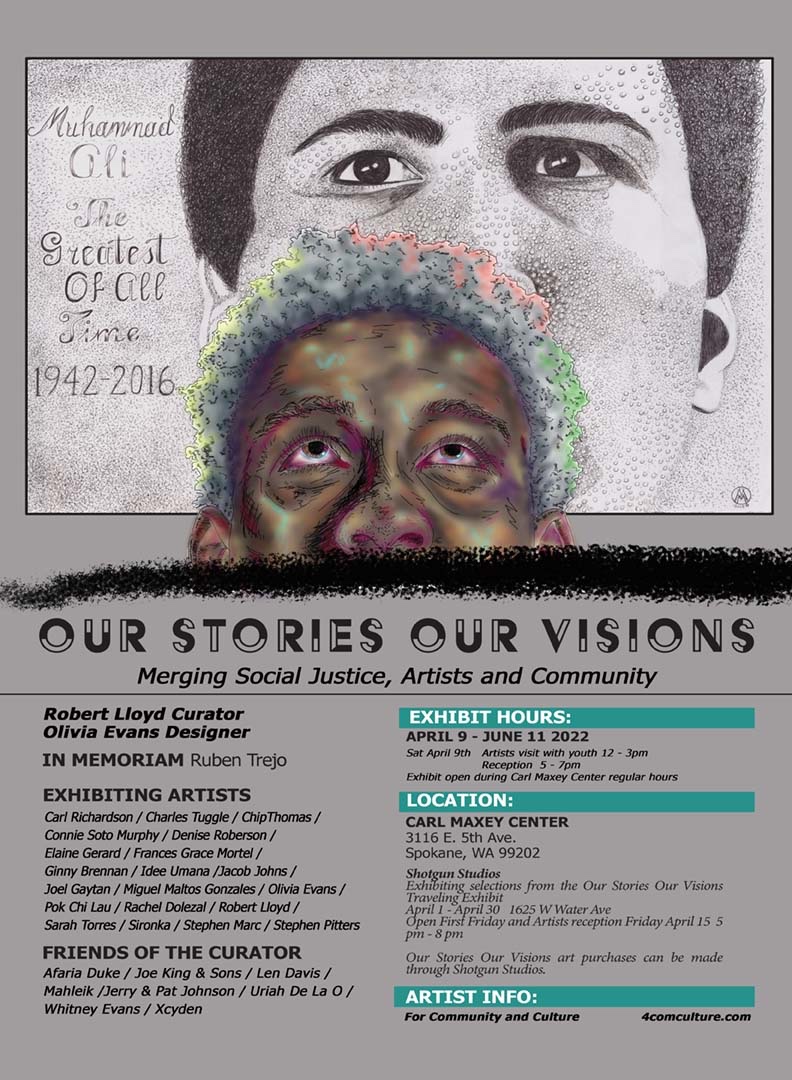
Our Stories Our Visions: Ali by Mahleik

The Way I Have Seen It: So I Vote

BLM Unity in Purpose

Image

 We have many styles but we are uniting. For unity and purpose. Buy a sign place it in your yard or window let us know that you're with us.

We have many styles but we are uniting. For unity with purpose. Buy a sign place it in your yard or window let us know that you’re with us.

Abolish the Police – Why?

An insider with ten years of experience says

Do not talk to cops and never, ever believe them

If you take only one thing away from this essay, I hope it’s this: do not talk to cops.
But if you only take two things away, I hope the second one is that it’s possible to imagine a different world where unarmed black people, indigenous people, poor people, disabled people, and people of color are not routinely gunned down by unaccountable police officers. It doesn’t have to be this way.
If you take only three things away from this essay, I hope the third is this: you and your community don’t need bastards to thrive.

Let me tell you what probably won’t solve the problem of bastard cops

  • Increased “bias” training. A quarterly or even monthly training session is not capable of covering over years of trauma-based camaraderie in police forces.
  • Tougher laws. Cops do not follow the law and will not hold each other accountable to the law.
  • More community policing programs. Many of the cops pepper-spraying journalists were probably the nice school cop a month ago.

No tweaks

Instead of wasting time with minor tweaks, I recommend exploring the following ideas:

  • No more qualified immunity. Police officers should be personally liable for all decisions they make in the line of duty.
  • No more civil asset forfeiture. You lose more cash and property to unaccountable civil asset forfeiture than to all burglaries combined.
  • Break the power of police unions. Police unions make it nearly impossible to fire bad cops.
  • Require malpractice insurance. If doctors have to have it, police ought to have it.
  • Defund, demilitarize, and disarm cops. Cities are not safer when unaccountable bullies have a monopoly on state violence and the equipment to execute that monopoly.

One final idea: consider abolishing the police.

The above page has been paraphrased. If you want to know how this insider came to these conclusions read the complete story:

Confessions of a Former Bastard Cop