Riders for Race Amity is a biking initiative dedicated to fostering racial healing and unity. Cyclists journey from Madison, WI to Montgomery, Alabama, visiting historical sites and engaging in Restorative Justice Circles along the way. By promoting dialogue, reflection, and action, the ride raises awareness of racial biases and connects participants with the principles of the Copper to Gold program. Through community engagement and meaningful conversations, Riders for Race Amity strives to build bridges across racial divides and inspire lasting change.
To learn more and help support these young people creating unity go the their website:
CORE’s (Congress of Racial Equality) Rules for Direct Action became a model for nonviolent resistance worldwide. Their emphasis on preparation, discipline, and moral clarity ensured that their actions were both effective and ethically grounded. These principles continue to influence modern social movements, from environmental activism to racial justice campaigns. By combining strategic planning with cultural tools, CORE and similar organizations demonstrated the power of nonviolence in achieving systemic change.
CORE’S Rules for Direct Action full article CLICK HERE
Social justice is a complex and multifaceted challenge, but solutions are possible through systemic reforms, grassroots activism, and cultural shifts. By addressing inequality, promoting equity, and fostering inclusivity, we can create a more just and equitable society for all. These solutions require collaboration across sectors, sustained advocacy, and a commitment to the principles of human rights and dignity.
Since Trump’s second election I have been hearing talk that “We’re all in this together”.
Ultimately, the true meaning of “all” lies not in its historical usage but in the ongoing efforts to make it **genuinely inclusive**—a call to action for continued progress in the pursuit of justice.
Spokane, like many cities in the United State has seen its share of protests over the years. And year after year thousands show up at the Martin Luther King Rally and March. Who’s who of Black Spokane will show up. Black organizations and community centers show up. Church groups show up. Local press shows up. Politicians show up. They are ethnically and economically diverse. In 2011 there was a bomb found along the MLK March route. For the following year thousands more turned out for the march.
One of the current cliches is that we are all in it together. But how is this expressed in terms of social justice? In the constitution it says liberty and justice for all, but Blacks were counted as only 3/5ths of a person. The diversity of the nation has increased through immigration but we still all live in our silos and everyone was not and is not considered equal. One of most segregated organizations are our churches. But now when we are on the verge of a tyranny when everyone is losing their rights suddenly we are all in it together. But our protests are still segregated. The only diverse marches and rallies here in Spokane are the Martin Luther King rally and march in January of each year.
Thousands Turn Out in Spokane and The Nation
Our protests are not diverse. Think of these examples:
Civil Rights Movement (1960s -1970s) Vietnam War Protests (1960s -1970s) Environmental Movements (1970s – present) Indigenous Rights LGBTQ+ Rights Black Lives Matter (2010s – present) Protest Anti-Semitism Protest Anti-Muslim Open Housing Homeless Rights Economic and Labor Protests Anti-Trump Protests Women’s March
How do we all work together? When people leave the meetings and rallies they return to their homogeneous communities. Check out the following links for things that can be done in-between the significant emotional events of major protests.
Pass this out at every march, rally and meeting you attend
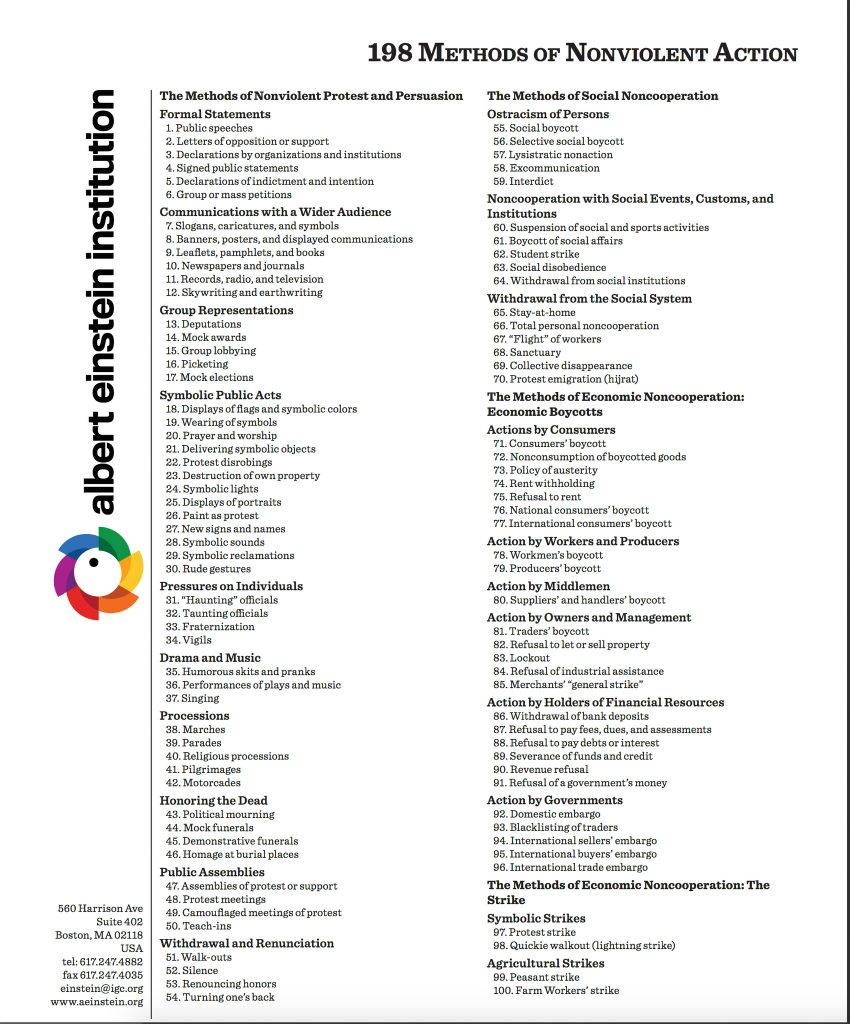
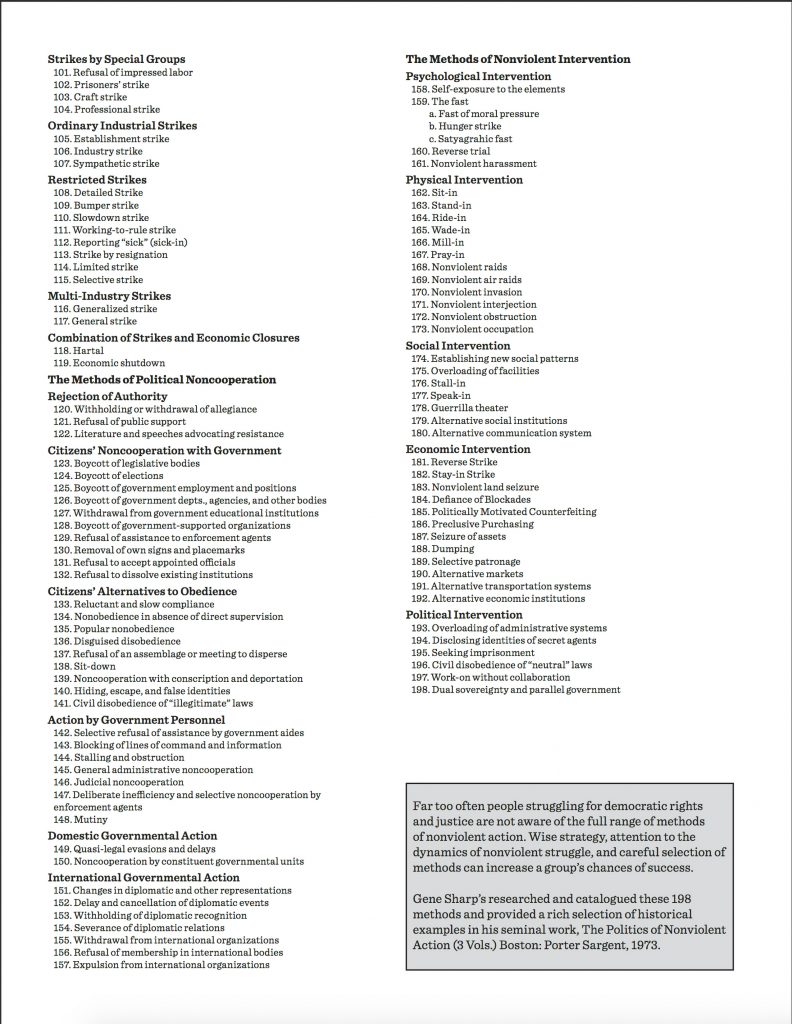
Practitioners of nonviolent struggle have an entire arsenal of “nonviolent weapons” at their disposal. Listed below are 198 of them, classified into three broad categories: nonviolent protest and persuasion, noncooperation (social, economic, and political), and nonviolent intervention. A description and historical examples of each can be found in volume two of The Politics of Nonviolent Action, by Gene Sharp
DEI (diversity, equity, inclusion) doesn’t affect me.
I’ve got a job.
I’m not an immigrant.
Addressing the question “if it doesn’t affect me directly, why should I care?”, it’s crucial to understand the broader impact of community organizations. Understanding and evaluating community organizations requires a multifaceted approach. By considering their effectiveness, transparency, coalition-building efforts, and legitimacy indicators, you can make informed decisions about which organizations to support and engage with. Remember that while an organization’s impact may not always be immediately apparent to you personally, their work often contributes to broader societal improvements that can benefit everyone in the long term.
Comprehensive Strategies to Regain Control and Protect Democratic Institutions from Systematic Dismantling
# Immediate Action Strategies
The success of these strategies depends on coordinated action across multiple sectors and sustained commitment to democratic principles. The research suggests that combining legal mechanisms, civil society action, and international support provides the most effective approach to protecting and restoring democratic institutions.
Persistent inequality is obviously serious, and if discrimination were the primary problem, then race-conscious remedies might be appropriate. But while white racism was central to the story in 1964, today the picture is much more complicated. Thus while blacks and whites now graduate at the same rate from high school today and are almost equally likely to attend college, on average they are not equally educated. That is, looking at years of schooling in assessing the racial gap in family income tells us little about the cognitive skills whites and blacks bring to the job market. And cognitive skills obviously affect earnings.
In the decades since affirmative action policies were first instituted, the poverty rate has remained basically unchanged. Despite black gains by numerous other measures, close to 30 percent of black families still live below the poverty line. “There are those who say, my fellow Americans, that even good affirmative action programs are no longer needed,” President Clinton said in July 1995. But “let us consider,” he went on, that “the unemployment rate for African Americans remains about twice that of whites.” Racial preferences are the president’s answer to persistent inequality, although a quarter-century of affirmative action has done nothing whatever to close the unemployment gap.